
By Andrew Phillip Chernoff | CanucksBanter
June 14, 2026
We begin deconstructing the 2023-2026 regression with a brief look at how and why, setting up the “what” has happened to right the team in the right direction so far, and some ideas on the blueprint to get the Canucks back to contending for the Stanley Cup over the next few years, without derailing the Canucks “train” off the proverbial railroad track.
The Precipitous Fall: Deconstructing the 2023-2026 Regression
To understand the magnitude of the rebuilding task ahead, one must first analyse the trajectory that forced the Vancouver Canucks into this position.
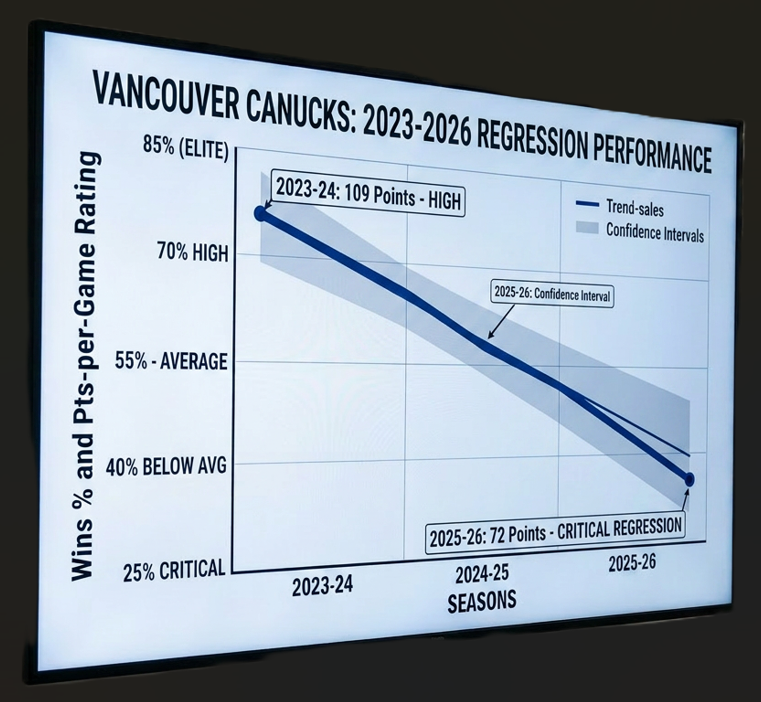
The 2023-24 season was hailed as a renaissance. Under Head Coach Rick Tocchet, the Canucks achieved 50 wins, driven by elite goaltending from Thatcher Demko, a 103-point campaign from J.T. Miller, and a Norris Trophy-winning performance from newly minted captain Quinn Hughes. The team boasted a +56 goal differential, advanced to the second round of the Stanley Cup Playoffs, and appeared poised for sustained success.
However, the underlying metrics suggested vulnerability, and the 2024-25 season confirmed those statistical regressions.
The Canucks fell to 38-30-14, managing only 90 points and dropping to fifth in the Pacific Division. The goal differential swung drastically to -17, and the team surrendered 253 goals. The most pivotal moment in the franchise’s modern history occurred midway through this disappointing campaign.
On 12 December 2025, recognising an impending contractual impasse and a fractured locker room dynamic, the Canucks executed a blockbuster trade, sending Quinn Hughes to the Minnesota Wild in exchange for defenceman Zeev Buium, forwards Marco Rossi and Liam Ohgren, and a 2026 first-round draft pick.
This transaction effectively closed the previous competitive window and initiated a hard rebuild.
The subsequent 2025-26 season laid bare the talent deficit. Under Adam Foote, who replaced Tocchet, the Canucks finished last in the NHL. The team’s 9-27-5 home record established a new franchise low for futility at Rogers Arena, and their -100 goal differential narrowly avoided eclipsing the all-time franchise worst of -117 set during the 1984-85 season.
The collapse was systemic. It wasn’t just goaltending or a scoring drought. Management, coaching, and the veteran core all failed during the downward spiral.
- Offensively, the Canucks were anaemic, averaging a mere 2.52 goals per game.
- Defensively, they surrendered a league-worst 316 goals.
- Goaltending instability further compounded the issue. With Thatcher Demko limited by severe hip and knee injuries that required surgery, the crease was surrendered to Kevin Lankinen and Nikita Tolopilo. Lankinen managed only 11 wins in 39 appearances with an .876 save percentage, while Tolopilo struggled to adapt to the heavy workload, underscoring the franchise’s critical lack of depth.
This Canucks failure necessitated the dismissal of Patrik Allvin and Adam Foote, shifting the burden of reconstruction to new GM Ryan Johnson and promotion of Manny Malhotra to Head Coach of the NHL team. And of course, the announcement of co-Presidents Daniel and Henrik Sedin.
Biometric Tracking and the Speed Deficit
The integration of artificial intelligence and player tracking has introduced an entirely new tier of performance indicators. Infrared microchips embedded in pucks and jerseys, tracked by league partners such as SportsMedia Technology, produce millions of data points per match. Companies like Sony-owned Hawk-Eye Innovations have further advanced this by collecting skeletal data, tracking twenty-nine specific points on a player’s body to evaluate agility, posture, kinetic efficiency, and hockey sense.
Applying these metrics to the 2025-26 Vancouver Canucks reveals profound athletic and tactical deficiencies that the new coaching staff must urgently address.
- NHL Edge data indicates a severe lack of team speed. Centre Max Sasson recorded the fastest skating burst for the Canucks at 38.13 kilometres per hour—a speed that ranked a mediocre eighteenth among individual team leaders across the NHL.
- The aggregate data is even more concerning.
- The Edmonton Oilers led the league with 268 bursts exceeding 35 km/h, while the Canucks ranked eighteenth with a mere 68. In the highly competitive 32-35 km/h tier, the Colorado Avalanche recorded 2,468 bursts compared to Vancouver’s 1,475, which placed them twenty-seventh in the NHL.
Offensively, the tracking data underscores a systemic failure to penetrate high-value ice.
- The Canucks finished twenty-fourth in high-danger shots, twenty-seventh in mid-range shots, and twenty-seventh in overall offensive zone time during the 2025-26 campaign.
- Furthermore, their shot velocity was sub-standard.
- While Elias Pettersson registered a 157.99 km/h shot and Brock Boeser hit 155.14 km/h, the supporting cast lacked raw power, evidenced by departed depth forward Kiefer Sherwood retaining top-five shot metrics despite leaving the team mid-season.
Manny Malhotra and his new coaching staff must improve on the biometric tracking and the speed deficit, implementing systems that actively reverse these tracking metrics.
Malhotra, renowned for his structural discipline and communication, must prioritise transition speed and inner-slot chance generation over perimeter possession. If the team’s 35 km/h burst frequency and high-danger chance generation increase during the 2026-27 season, the front office will possess empirical evidence that the rebuild is moving in the correct direction, regardless of the final standings.
Roster Architecture: The Cohort Theory of Contendership
In NHL hockey analytics—specifically within teambuilding frameworks popularized by sites like Puck Luck Analytics—a Contention Cohort is a core group of players intentionally drafted or acquired so that they hit their athletic primes at the exact same time.
Instead of having a scattered mix of aging veterans and undeveloped prospects, a front office builds a contention cohort to synchronize peak performance and maximize a franchise’s Stanley Cup window.
Key Characteristics of a Contention Cohort
- Age and Prime Alignment: Players in this cohort are usually within a few years of each other in age. Because NHL players generally hit their statistical peak between the ages of 25 and 30, synchronizing their development gives a franchise a roughly five-year window where its most impactful players are all performing at their absolute best simultaneously.
- Roster Density: The cohort is expected to fill the majority of the crucial positions in the top half to two-thirds of the active NHL roster once the team fully enters its contention phase.
- Draft-Built Foundations: An initial contention cohort is most frequently built during a full rebuild. The team tears down the current roster to acquire high draft picks over a few consecutive years. Notable examples of successful contention cohorts include the Tampa Bay Lightning core (Steven Stamkos, Victor Hedman, Andrei Vasilevskiy, Nikita Kucherov) and the Colorado Avalanche core (Gabriel Landeskog, Nathan MacKinnon, Mikko Rantanen).
- Secondary Cohorts: A primary contention cohort is rarely enough on its own to win a championship. Successful franchises typically supplement them a few years later with a “secondary cohort”—a subsequent wave of drafted prospects playing on entry-level contracts that provide high value, cap relief, and necessary depth.
In summary, a contention cohort isn’t just the players currently on the ice; it is a calculated timeline strategy. It represents a unified wave of talent moving through a franchise’s system together to create a sustainable, peak-performance championship window.
Historical analysis of the past five Stanley Cup champions reveals a distinct pattern in roster construction. Successful rebuilds do not merely draft high for a few years, sign a cluster of free agents, and immediately pivot to contention. Instead, they meticulously construct layered developmental cohorts.
The Contention Cohort
The first phase of a successful rebuild involves acquiring the primary “Contention Cohort.” This requires a complete teardown of the NHL roster to secure elite draft capital over successive seasons.
- The Colorado Avalanche (selecting Nathan MacKinnon first overall in 2013 and Cale Makar fourth overall in 2017) and the Florida Panthers (selecting Aleksander Barkov second overall in 2013 and Aaron Ekblad first overall in 2014) exemplify this strategy.
- This core group establishes the primary statistical baseline. Crucially, statistical modelling indicates that it requires approximately eight to ten years from these primary draft dates for a roster to reach its ultimate championship apex.
For Vancouver, the acquisition of this cohort is underway. Defenceman Zeev Buium, acquired in the Hughes trade, represents a foundational piece.
- Despite lacking elite shot velocity (topping out at 135.02 km/h), Buium ranked in the 88th percentile for offensive zone possession time, demonstrating elite play-driving capability at just twenty years of age.
- Alongside Tom Willander and Liam Ohgren, this group forms the bedrock of Vancouver’s future.
The Secondary Cohort
The difference between successful rebuilds and perpetual stagnation lies in the “Secondary Cohort.” Approximately four years before a championship window opens, front offices must aggressively hoard draft picks, frequently exceeding their allotted seven selections per year. This secondary wave provides vital depth on highly valuable, cost-controlled Entry-Level Contracts. This internal salary cap efficiency allows the franchise to retain its expensive primary stars without sacrificing roster depth.
- The Tampa Bay Lightning utilised this secondary cohort masterfully, drafting and developing players like Anthony Cirelli and Ross Colton to insulate their superstars.
- The Avalanche supplemented their core with Bowen Byram and Alex Newhook, while the Vegas Golden Knights integrated Paul Cotter and Peyton Krebs to facilitate major trades.
Conversely, the Toronto Maple Leafs represent a glaring cautionary tale regarding failed cohort management.
- Armed with a formidable primary cohort featuring Auston Matthews, Mitch Marner, and William Nylander, Toronto opted to go “all-in” prematurely.
- They repeatedly traded away future draft capital to acquire veteran rentals.
- By failing to cultivate a secondary drafted cohort on entry-level deals, they severely restricted their salary cap flexibility. This forced them to rely on minimum-wage veterans to fill out their roster, resulting in repeated postseason failures and organisational paralysis.
For the Vancouver Canucks, the 2026-27 and 2027-28 seasons represent the critical accumulation phase for the secondary cohort.
- Following years of aggressive asset management, the Canucks possess an unprecedented ten draft picks in 2026, including two in the first round, alongside nine picks in both the 2027 and 2028 drafts.
- General Manager Ryan Johnson must resist any temptation to trade these assets for immediate NHL assistance, instead focusing entirely on saturating the Abbotsford Canucks with elite prospect depth.
Next time
The next post in this series will go into Cap Management and the upcoming 2026 NHL Draft.
- The Canucks are projected to enter the off-season with approximately $23.9 million in cap space, a figure that provides Ryan Johnson with immense strategic flexibility. Understanding how to leverage daily cap space is a vital tool for rebuilding because cap space is calculated daily, so maintaining a roster well below the ceiling early in the season allows a franchise to accrue significant financial flexibility closer to the trade deadline.
- Despite dropping in the order at the Draft Lottery, the third overall selection provides the Canucks with a premium foundational asset in a draft class marked by diverse, high-end talent. The top of the board features elite wingers like Gavin McKenna and Ivar Stenberg, center Caleb Malhotra, alongside a formidable crop of defencemen including Chase Reid, Keaton Verhoeff, Carson Carels, and Alberts Smits.
Until next time, hockey fans
Discover more from CanucksBanter
Subscribe to get the latest posts sent to your email.