

By Andrew Phillip Chernoff | CanucksBanter
December 03, 2025
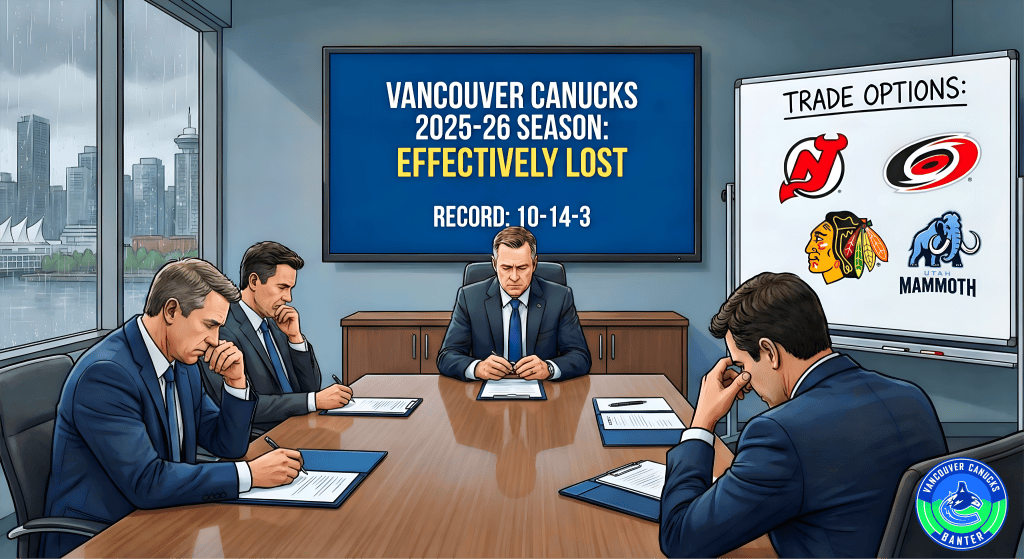
The defining moment of an NHL season can be a rather a brutal, cold realization. For the Vancouver Canucks hierarchy and its fanbase, that moment may have unfortunately arrived in early December 2025. A glance at the standings, and the injuries continuing, reveals a stark truth that optimism can no longer obscure: a 10-14-3 record isn’t merely a slump; it is an indictment of the roster’s current construction, and the toll that the season has had on the team to this point of the season.
It is time to shelf any lingering aspirations for championship contention in the 2025-26 campaign. This specific mix of personnel has proven itself to be volatile, operationally flawed, and incapable of the consistency required to be a legitimate threat. They are playing their hearts out, gallantly giving their all in every game.
Management must now seriously consider decisive action and real-time possible scenarios to finish the season on a positive note, if the playoffs are truly unreachable in their current state.
The focus must shift immediately from salvaging the present to securing the future, necessitating difficult but essential trade calls with potential partners like the New Jersey Devils, Carolina Hurricanes, Chicago Blackhawks, and the Utah Mammoth.
The goal of reaching the playoffs may be fleeting, but the opportunity to reshape the franchise’s trajectory could be just beginning, depending on how management and ownership respond to Canucks ‘crisis’ crisis-filled season to this point.
The New Jersey Devils
The “Hughes Brothers” storyline is the worst-kept secret in the NHL. Jack and Luke Hughes are cornerstones of the New Jersey Devils. With Quinn Hughes reportedly facing “taming” in Vancouver and the team spiraling, the Devils are the only logical destination for a trade that alters the landscape of the league.
Devils’ Financial & Roster Reality:
- Cap Space (2025-26): ~$3.6M deadline space.
- Cap Space (2026-27): ~$11.13M opening space.
- Roster Redundancy: The Devils have Dougie Hamilton ($9M) and Brett Pesce locked in on the right side. This makes Simon Nemec (2nd overall, 2022) a luxury asset. Nemec is an elite RHD prospect/player but is blocked from top-pair minutes.
- Asset Pool: Simon Nemec, Seamus Casey (D), Dawson Mercer (F), Lenni Hameenaho (F).
Operational Analysis:
- For Vancouver: This trade meets and exceeds the Seth Jones Benchmark. They acquire a future #1 defenseman (Nemec), a top-six forward (Mercer), a B+ prospect (Casey), and a 1st round pick. Taking on Palat is the “tax” paid to get Nemec. This instantly resets the franchise’s age curve and culture.
- For New Jersey: They form the most dynamic defense core since the 2000s Red Wings. A top four of Q. Hughes, L. Hughes, D. Hamilton, and B. Pesce is a cheat code. The $104M cap in 2026 allows them to absorb Quinn’s deal comfortably alongside Jack and Luke.
- Feasibility: Reports indicate New Jersey explored trading Nemec in the offseason. With the Devils’ right side crowded, Nemec is the specific asset Vancouver must demand.
The Carolina Hurricanes
The Narrative:
The Carolina Hurricanes are perennial contenders operating with internal budget discipline. However, they face a massive decision with Martin Necas. Necas signed a 2-year, $13M ($6.5M AAV) deal that walks him to unrestricted free agency (UFA) in 2026.29 If they cannot extend him, they must trade him. Conversely, Vancouver needs to shake up its mix.
Hurricanes’ Financial & Roster Reality:
- Cap Space: ~$39M in deadline space (due to LTIR/accrual), but tight on actual dollars long-term.
- Prospect Pool: Deepest defense pool in the league, led by Alexander Nikishin, widely considered the best prospect outside the NHL.
- Strategic Need: Elite game-breaking talent at center/wing to push them over the playoff hump.
Operational Analysis:
- For Vancouver: This follows the Jack Eichel Benchmark. They get an established top-line player (Necas) who fits a faster style of play. If Necas refuses to sign long-term, Vancouver can flip him at the 2026 deadline for a massive return (the “Elias Lindholm strategy”). Scott Morrow gives them another high-end RHD prospect to pair with Nemec (from the NJD trade).
- For Carolina: They get cost certainty. Pettersson is signed long-term. While the $11.6M cap hit is high, Vancouver retaining $1.5M brings it down to ~$10.1M, which fits perfectly into Carolina’s 2026 structure (replacing the expiring Brent Burns and Necas money). Pettersson’s responsible defensive game is a perfect fit for Rod Brind’Amour’s system.
- The Nikishin Factor: While Vancouver should ask for Alexander Nikishin, Carolina likely deems him untouchable. Morrow is the realistic “A” prospect target.
The Chicago Blackhawks
The Narrative:
The Chicago Blackhawks are exiting their “scorched earth” rebuild. With Connor Bedard entering his prime, they need to surround him with talent and reach the salary floor. They have $66 million in deadline cap space 33 and a mandate to get better.
Blackhawks’ Financial & Roster Reality:
- Cap Space: Infinite ($53M+ projected in 2026).
- Prospect Pool: Artyom Levshunov, Frank Nazar, Oliver Moore, Kevin Korchinski.
- Need: Size on defense and “reclamation” projects that fit the timeline.
Operational Analysis:
- For Vancouver: This is primarily a cap-clearing move to facilitate the “Reset.” Moving Tyler Myers allows younger defensemen (like Willander or Solberg) to play. Acquiring Kevin Korchinski is a calculated gamble. The 7th overall pick in 2022 has struggled defensively, but Vancouver’s development staff (Gonchar/Foote) may view him as a project similar to a young Quinn Hughes—elite skater who needs structure.
- For Chicago: They bring back Reichel for pennies on the dollar to see if he can find his game in a familiar environment. They take Myers ($6M) to help reach the floor and protect Bedard physically. Myers is a perfect “bridge” veteran for a young team.
Utah Mammoth
The Narrative:
The Utah Mammoth (formerly Arizona Coyotes) is the aggressive new player in the market. Under new ownership, they are looking to make a splash. They have a mountain of draft capital (including multiple 2nd and 3rd rounders) and a desire to market the team with goal scoring.
Utah’s Financial & Roster Reality:
- Cap Space: Projected $27.7M in 2026.
- Draft Capital: They own all their own 1sts and have accumulated extra picks from trades (e.g., TOR 3rd, EDM 4th).
- 2025 Draft: Selected Caleb Desnoyers #4 overall, signaling a commitment to high-end skill.
Operational Analysis:
- For Vancouver: This move liquidates the “middle class” of the roster. Boeser and Hronek are quality players, but they are expensive and keep the team in the “mushy middle.” Maveric Lamoureux (6’7″ RHD prospect) adds the size Vancouver desperately lacks on the back end. The influx of 2nd and 3rd round picks allows Vancouver to take multiple swings in the deep 2026 draft.
- For Utah: They get instant credibility. Boeser is a recognizable star who scores goals. Hronek is a legitimate top-4 defenseman. Utah has the cap space to absorb their contracts easily without impacting their long-term extensions for Guenther and Cooley.
Next time in the final of this series: The road map to 2026.
The Vancouver Canucks must recognize that the 2025-26 season is effectively lost in terms of championship contention. The 10-14-3 record is a signal that the current mix is volatile and operationally flawed.
To do nothing, is not open for discussion. To act as a knee jerk reaction is not sound. To take a thoughtful pause, weigh all the options, the downside and upside is prudent. In the end of it all, change is inevitable and must be accepted.
How much change? Exactly when to “pull the trigger”? Whose to go? As the old saying goes, timing is everything.
But it’s time.
Until then, hockey fans
Discover more from CanucksBanter
Subscribe to get the latest posts sent to your email.