


By Andrew Phillip Chernoff
September 12, 2025
The Aquilini family fortune is substantially tied to building and real estate through their Aquilini Investment Group (AIG). Their foundation in the industry was established by patriarch Luigi Aquilini. It includes developing thousands of residential units, hotels, and commercial properties. They also engage in large-scale projects and land development.
The AIG’s diverse portfolio is valued in the billions. It also encompasses agriculture, tourism, and sports. Yet, its roots and significant assets remain deeply connected to construction and real estate development.
And yet, despite their wealth and skill in building, the Aquilini family has never managed to build a hockey dynasty. They haven’t even managed to create a perennial contender.
Lack of Training Center Puts Canucks At Competitive Disadvantage
Ownership and management can improve their chances of winning the Stanley Cup. They can do this by providing the players with a modern training center.
The Calgary Flames will soon have a training center as part of their new arena. That leaves the Canucks as the only NHL team without their own training center.
The Canucks fail to invest sufficiently in the team to succeed. And it poses particular challenges.
There is a need to focus on mitigating the effects of not having a training center. Some challenges are day-to-day. Others occur seasonally, including travel-related challenges.
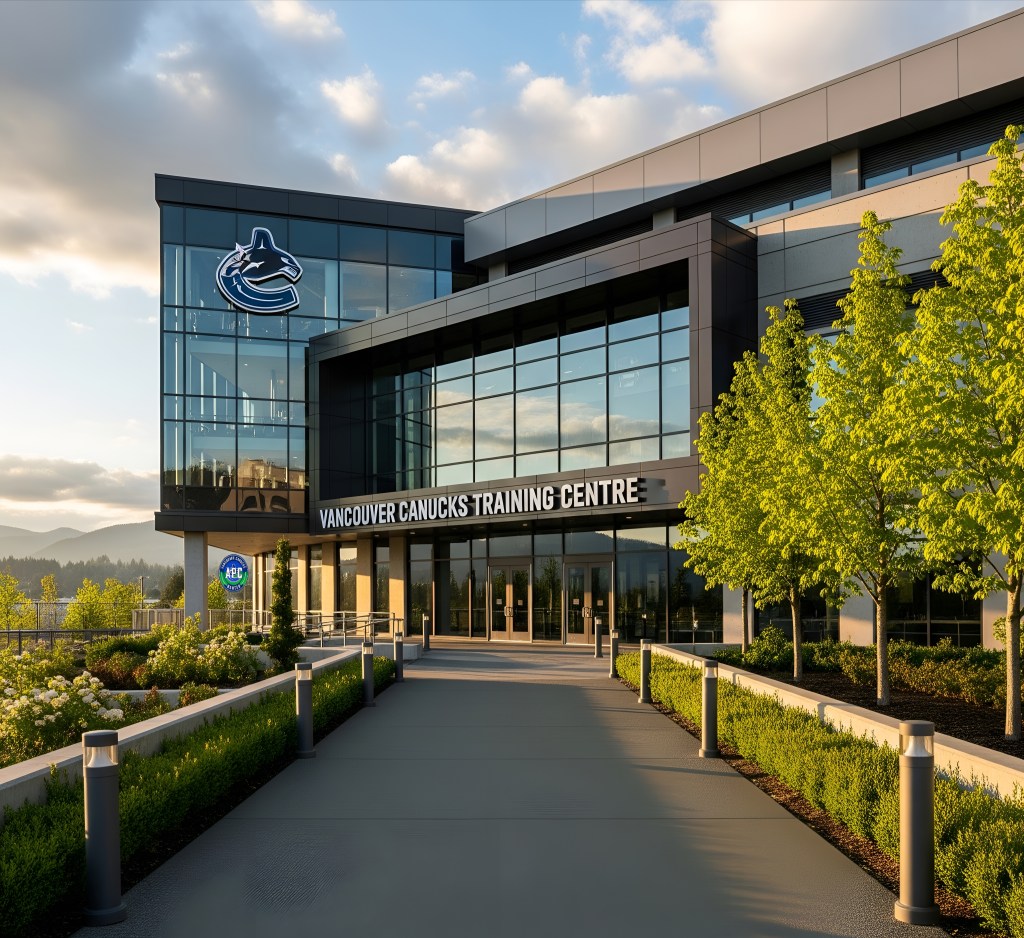
The lack of a dedicated training center for the Canucks is a significant disadvantage, as it undermines the team’s ability to execute a sound strategic plan and adversely affects their season success in several key ways:
1. Inefficient Use of Time and Energy
- Commuting: Players and staff must travel to a different location for practice. They often go to the University of British Columbia (UBC) or other community rinks. This adds wasted time and energy to an already grueling schedule. This is especially true on days they aren’t traveling for a road game. For a team focused on optimizing every aspect of performance, this is a major operational inefficiency.
- Logistics: The team’s equipment and support staff must constantly move gear between Rogers Arena and the off-site practice facility. This is an unnecessary logistical burden that can be a minor annoyance or a major headache, depending on the situation.
2. Training and Recovery At Risk
- Ice Time and Availability: The Canucks are affected by the schedule of other events at Rogers Arena. They also rely on the availability of their alternate practice rinks. This can lead to irregular practice times or even missed practices, making it difficult to keep a consistent routine. A dedicated facility would allow for a flexible practice schedule. It would give the ability to add sessions as needed for individual player work. It also accommodate tactical tweaks or recovery skates.
- Integrated Facilities: A dedicated training center allows for a seamless flow between on-ice and off-ice activities. Players can skate. Then, they can move promptly to a modern weight room. They have access to a specialized recovery center with cryotherapy and hydrotherapy. There is also a nutrition station—all under one roof. Without this, the team’s ability to offer a comprehensive, integrated training environment is compromised. This situation is especially critical for a team experiencing the fatigue of a heavy travel schedule. Immediate and effective recovery is key.
- In-house Staff and Support: There is a lack of a central hub. This makes it harder for coaches, trainers, physiotherapists, and medical staff to access players continuously. It becomes challenging for them to give consistent support, which in turn limits their direct contact. A dedicated facility fosters a professional atmosphere. A player can pop in at any time to work with a specialist. This is a significant factor in proactive injury prevention and management.
3. Player Retention/Acquisition Disadvantage
- Perception: In today’s NHL, a dedicated, cutting-edge training facility is a standard expectation. Being one of the only teams without one is a negative mark against the organization’s reputation. It can make a potential free agent question the organization’s commitment to winning. A player considering a contract extension also questions their players’ well-being.
- The “Stick vs. Carrot” Approach: Some reports have mentioned this. The Canucks want players to spend their off-season in Vancouver. They should train at the team’s facility. Still, without a modern center, they lack the “carrot” to entice players to do so. A player will opt to train at a facility closer to their off-season home. This choice limits the team’s ability to oversee their development. It also affects the building of team chemistry outside of the regular season.
In essence, the lack of a dedicated training center acts as a multiplier of the negative effects of travel and other in-season and off-season challenges:
- It is a fundamental issue.
- This problem complicates every aspect of a strategic management plan.
- It affects daily operations and player well-being.
- It also impacts long-term roster construction.
Impact of Travel
The impact of travel, particularly for a team like the Vancouver Canucks located on the West Coast, can’t be overstated.
Years down the road, teams will probably have sophisticated strategies to counter this, but until then the inherent challenges persist:
- Fatigue and Performance Decline:
- Time Zone Changes: Frequent East-West travel leads to circadian rhythm disruption, affecting sleep quality, concentration, and physical performance.
- Wear and Tear: Constant flights, bus rides, and hotel stays contribute to physical fatigue, increasing the risk of injuries.
- Back-to-Back Games: Travel amplifies the difficulty of playing consecutive games, often leading to decreased performance in the second game.
- Mitigation Strategies:
- Advanced Scheduling: The NHL and individual teams will continue to improve schedules. They aim to reduce travel disruptions where possible. Still, geographical realities limit this.
- Charter Flights and Amenities: Providing the most comfortable and efficient travel possible, including onboard physiotherapy and nutrition, helps reduce stress.
- Sleep and Recovery: Strict sleep hygiene, individualized recovery plans, and access to specialized recovery tools (e.g., cryotherapy, massage) will be even more ingrained in daily routines.
- Load Management: Strategic resting of players will become more common. This is especially true for veterans or those with minor ailments. The goal is to keep them fresh for crucial stretches of the season and playoffs.
- Nutritional Support: Tailored meal plans offer necessary sustenance. Hydration strategies are essential before, during, and after travel. These are crucial for maintaining energy levels. They also aid in recovery.
- Competitive Disadvantage Handling:
- Teams with less demanding travel schedules (often those in the Eastern Conference) inherently have a slight advantage.
- For the Canucks, as a team and individually, overcoming this means excelling in areas they “can control“: conditioning, mental state. A deep roster can absorb fatigue. Effective player management of their team and personal routines is essential.
Aquilini Brother Buyout Puts Canucks Capital Projects On Hold
The departure of Paolo Aquilini from the Aquilini Investment Group is due to a “private family matter.” Public statements, legal filings, and industry reports show internal family conflicts. They also show that business restructuring requirements are required sooner rather than later to deal with these matters. Family trusts make a quick solution difficult at best.
The financial pressure is facing both Paolo personally and the Investment Group directly. The process of separating Paolo’s stake from the family’s vast, multi-billion-dollar empire is ongoing. This situation has left the Vancouver Canucks vulnerable to potential impacts. This has caused a ripple effect throughout the Canucks Sports and Entertainment organization.
With respect to the Canucks Sports and Entertainment, the cumulative effect of the above issues has:
- Created operational uncertainty.
- This situation has led to a challenging operational environment.
- These issues have affected brand perception.
- The brand perception affects the Canucks organization’s ability to attract and keep talent.
- This impact is felt from the front office to the coaching staff to the players, including the fan base.
Francesco Aquilini’s standing and popularity among other owners in the NHL are not good, and he deserves it.
The fans are the lifeblood of the sports industry.
Without fans, there would be no demand for sports, and the entire sports ecosystem would collapse.
Fans give the energy and excitement that make sports events so compelling. They are why sports franchises and leagues can generate significant revenue. Fans can be highly engaged. They join in fantasy leagues, bet on games, and buy merchandise to support their favorite teams and athletes.
The Vancouver Canucks are entwined in the social scene of the Lower Mainland. They are also wrapped up in the province’s entertainment and sports scene. While they are not too big to fail, their impact and reach are extensive.
The Vancouver Canucks are not a “private family matter”.
The Aquilini Investment Group’s approach to Paolo Aquilini’s buyout will decide the future of Canucks Sports and Entertainment. It will directly affect the sustainability of the Vancouver Canucks.
The family has repeatedly denied that a sale of the team is under consideration. The team’s value is high and should be an attractive investment for a potential suitor.
Nevertheless, AIG’s mounting financial pressure and the crisis in public trust perception are issues. Thus, the family need to bring in a minority partner. If not for the team, then for the Aquilini Investment Group.
This step will appease the fans and the NHL. This will occur if it is at least a minority partner for the team. It will be even better if the person/organization becomes a full owner.
It would help the team stay stable, functional and financially healthy. This step will increase the likelihood of having a modern multi-purpose training facility for the team.
Other capital projects that help the team and its brand also have a reasonable probability of occurring.
One thing is clear.
The Aquilini Investment Group holds majority ownership in the Vancouver Canucks. This means that what happens with AIG is not just “a private family matter”:
- The Aquilini Investment Group has a responsibility to Vancouver Canucks players and staff to foster a stable culture.
- Aquilini Investment Group also has a responsibility to the community.
- This involves ensuring it has and follows ethical business practices across its entire corporate organization. This includes philanthropic responsibilities in the community.
- Aquilini Investment Group also has responsibilities to the National Hockey League to uphold its integrity and financial health.
- Aquilini Investment Group is a private company. It conducts business in the Lower Mainland, throughout the province, the country, and the world.
- And it has responsibilities to uphold an impeccable image of integrity and trust.
- Aquilini Investment Group has a responsibility to their “stakeholders”. By way of its “social contract”.
- This contract requires not only financial health and stability but also transparent leadership. It demands ethical business practices and a clear, consistent vision for the future.
What Do We Want? A Perennial Contender
Francesco, we want you and your investment group to make it possible for the Canucks to become a perennial contender. We want them to rise in the NHL. We want you to help put the team in the position to win Stanley Cups.
What is a perennial contender you ask?
A perennial contender in sports is a team that consistently performs at a high level. It is expected to be a top competitor for a championship year after year. Unlike a “flash in the pan” team that has one good season, a perennial contender shows long-term excellence. It achieves sustained success.
Key characteristics of a perennial contender:
- Consistent winning record: The team maintains a high winning percentage over many seasons, typically avoiding long stretches of losing.
- Regular playoff presence: It consistently qualifies for the postseason, often as a top seed in its conference or division.
- Deep playoff runs: Perennial contenders often advance beyond the first or second round. They regularly compete in conference championships or finals.
- Talented core: The team is built around a strong and reliable core of elite players. These players are often in their peak competitive window.
- Strong organizational structure: Success is not reliant on a single player. These organizations have strong coaching, management, and scouting that allow them to continuously replenish talent.
- Adapts to challenges: Perennial contenders can overcome setbacks like player injuries, roster changes, and salary-cap constraints to remain competitive.
The Vancouver Canucks need a clear and determined future. This will help sustain their stability and viability in the community and province for another 55 years.
More than that, the past narrative of the Vancouver Canucks’ history will change. There would be an opportunity to write more successful chapters.
These chapters will highlight them as a perennial contender a higher percentage of the time. This is better than being a “flash in the pan” team. This type of team has one good season every 4-6 years or longer.
If you can’t do it, Francesco, sell it to somebody who can and will do a better job of it.
Until next time, hockey fans
Discover more from CanucksBanter
Subscribe to get the latest posts sent to your email.