

By Andrew Chernoff
August 30, 2025
The Canucks’ front office, led by President of Hockey Operations Jim Rutherford, General Manager Patrik Allvin, and Head Coach Adam Foote, has created a multi-layered management-coaching philosophy built on a high-trust, collaborative approach that prioritizes a player-led culture of accountability. Not to be lost or forgotten is the management of “the assets and finances.”
Together, the three amigos make up the F.A.R. Team of Foote, Allvin and Rutherfood, whose function is to “prod” the team to success, F.A.R. steering them into the 2026 Stanley Cup playoffs, to the Stanley Cup Final, and to claim the ultimate prize in professional league sports: Lord Stanley’s Cup.
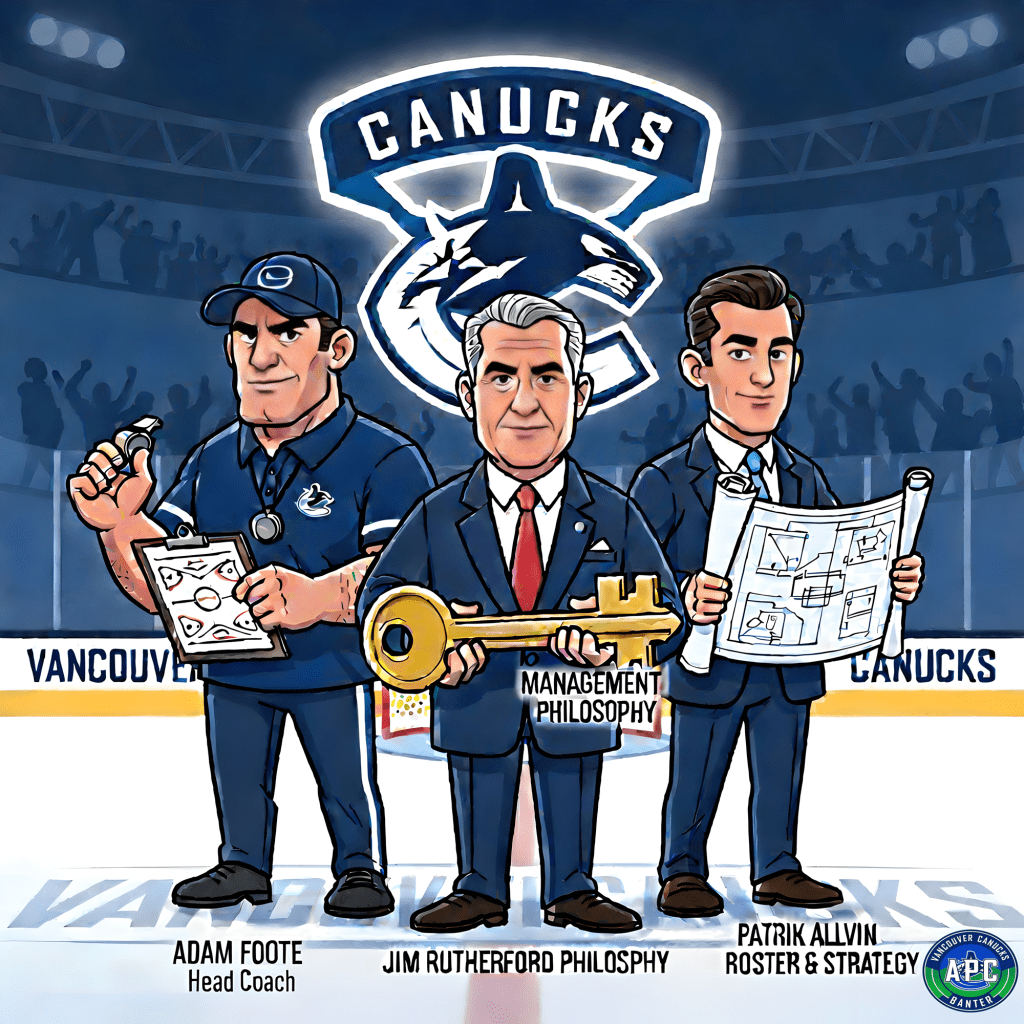
Rutherford’s proven championship experience, Allvin’s detail-oriented culture, and Foote’s core coaching philosophy, led by his core belief that success is “It’s their room”, and a player-driven culture of accountable on-ice execution of play, with a bounce-back attitude controlled and demanded by the players’ leadership.
THE “R.” IN ‘FAR’
Besides being a three-time Stanley Cup champion and Hockey Hall of Fame builder, Rutherford tells it like is with anybody who will listen.
From my research for this article, I have discovered that Rutherford is known for a straightforward, dual-pronged strategic approach, to….building a winner.
- First, the “Contender’s Gambit”
- Willingness to “overpay for a player” if the team has a good shot to go far in the playoffs. All about acquiring the right asset or assets nearing the season end to make the gambit.
- Second, a counterpoint to the first above, which embodies a different mindset that ensures the long-term financial and organizational sustainability of the team for years to come.
- This mindset involves being in the moment, and adjusting one’s view, considering things down the road, like the trade deadline, free agency, and other factors, like how likely a “What if…” could be; not necessarily stressing about it, but considering because a team can control only so much.
The moves by Allvin and Rutherford this 2025 postseason are one of being fiscally responsible and focused on making asset-oriented trades for prospect management and anticipated roster build-up at a particular position, especially with one-way contracts. Examples, being Dakota Joshua and Arturs Silovs.
THE “A.” IN ‘FAR’
Allvin “believes that a successful organization is a ‘partnership between ownership, management, coaches and the players’ all of whom must be ‘invested, committed, [and] focused’.”
- For Allvin, this is a “never-ending” pursuit of excellence where complacency is the enemy; the day you are satisfied is the day you are done. His model establishes a clear chain of accountability: his job is to “push the coaches,” and the coaches’ job is to “push the players”.
Allvin’s philosophy emphasizes:
- Team identity comes from players making individual sacrifices for the greater good
- Success requires a full organizational commitment to daily improvements
- Team’s “core identity” comes from re-signing key players and attracting new talent who demonstrate a desire to be in Vancouver
- Investment in scouting and the development pipeline globally to find players who fit the demanding “Canucks hockey” style is crucial, leaving “no stone unturned.”
Allvin’s Training Camp Crucible:
A significant part of Allvin’s management approach for establishing the Canucks’ on-ice identity and a roster of players committed to a higher standard of play is instituting his “strategic crucible” at Vancouver training camps.
The goal from Day 1 at training camp is to “have a different level of expectation and “not waste any time” in having the players respond to it. This is designed to put the squads on a “path to accelerated improvement” and “trust built between the players and coaches”.
The expectation for Allvin is that the team attitude, work ethic and player bonding begin with a high expectation of buy-in.
He expects all “seasoned veterans to young prospects, to demonstrate “consistency” and “hunger” and to “keep raising the bar”. For young players in particular, training camp serves as a “good test” to see how they handle the intensity and physical play of bigger, older players.
THE “F.” IN FAR
Adam Foote’s “It’s Their Room” coaching doctrine appears to be a response to the disappointing 2024-25 Canucks season, characterized by poor on- and off-ice culture and play, which directly led to this coach’s strategy and doctrine, given his intimate knowledge of the Canucks’ internal dynamics last season.
Rutherford purposely hired Foote for his exposure to all that went down last season, so why not put him directly on the “hot seat” for the coming season, and give a previous one-time “hotshot” player a chance to rocket up the head coaching ranks, starting with the Canucks.
Empowering A Player-Led Culture
Management believes they have removed a significant part of the perceived source of dysfunction last season, and now Foote has the pleasure of instituting the recovery and healing of the team culture, much like a ‘hockeymaster’, not to be confused with a schoolmaster.
And Rutherford is a fair boss; he believes his new coach will need “at least 40 games to get up to speed on these complex internal issues.”
Foote gets to play team builder and soothsayer, cementing the foundation of the roster that will make the team from the 2025 training camp.
The onus of Foote putting accountability squarely on the players and believing the team belongs to them, and it’s up to the leadership group to enforce the team’s standards and hold each other accountable, rises from his days with the Colorado Avalanche.
Meanwhile, one has to believe that upper management will be watching closely to entrust players’ leadership with policing their own people. Actually believing that a culture of accountability from within the players group “is more potent and sustainable than one imposed from the top down.”
Foote expects the players to push each other in practice and to “reel in” any teammate who goes “rogue once in a while”. Maturity and motivation levels will surely be put to the test.
Foote and His Defensive Strategy To Generate Offense
Foote is going back to the NHL days when defence and goaltending won Stanley Cups, and goals were just about winning games, when you could get them from throughout the lineup.
Foote, like GM Patrik Allvin, believes that the team’s defense, which he considers “top five in the League,” is capable of contributing more offensively beyond Quinn Hughes. The expectation is that the defense corps will join the rush and generate a “second wave of a threat,” allowing the team to play faster and more connected.
Foote believes he will have the leverage in the team’s defensive depth by the end of the 2025 training camp to create more shots from the point and get to the “harder areas” of the offensive zone.
Translating Philosophy Into Reality
The strategic philosophies of Rutherford, Allvin and Foote were involved in roster decisions during the 2025 postseason, and will continue through training camp, and after on the waiver wire, and perhaps strategic trades.
The team added Evander Kane, acquired from the Edmonton Oilers. Dakota Joshua traded to the Toronto Maple Leafs; Arturs Silovs traded to the Pittsburgh Penguins.
Brock Boeser and Thatcher Demko re-signed. Chase Stillman, acquired in the Pittsburgh trade.
In my opinion, the offseason transactions and the philosophies of Foote, Allvin and Rutherford (the FAR Team) are likely to resemble the 2024-25 roster.
Unfortunately, the core of the team is not as strong currently, with no adequate replacement of this writing to replace the loss of J.T. Miller to the Rangers last season.
Defensively, and in the area of role players, I am taking the “seeing-is-believing” attitude, as training camp has yet to start at the time of this writing.
The loss of Carson Soucy and Dakota Joseph, who brought grit and a touch of much-needed leadership and goal-scoring, will not be easy to replace at the time of this writing.
Cheers, F.A.R. live long and prosper, a blessing to your people and a desire for “well-being and prosperity” for the Canucks in the upcoming season and beyond.
Until next time, hockey fans
Discover more from CanucksBanter
Subscribe to get the latest posts sent to your email.