
By NHL.com @NHLdotcom
June 24, 2023
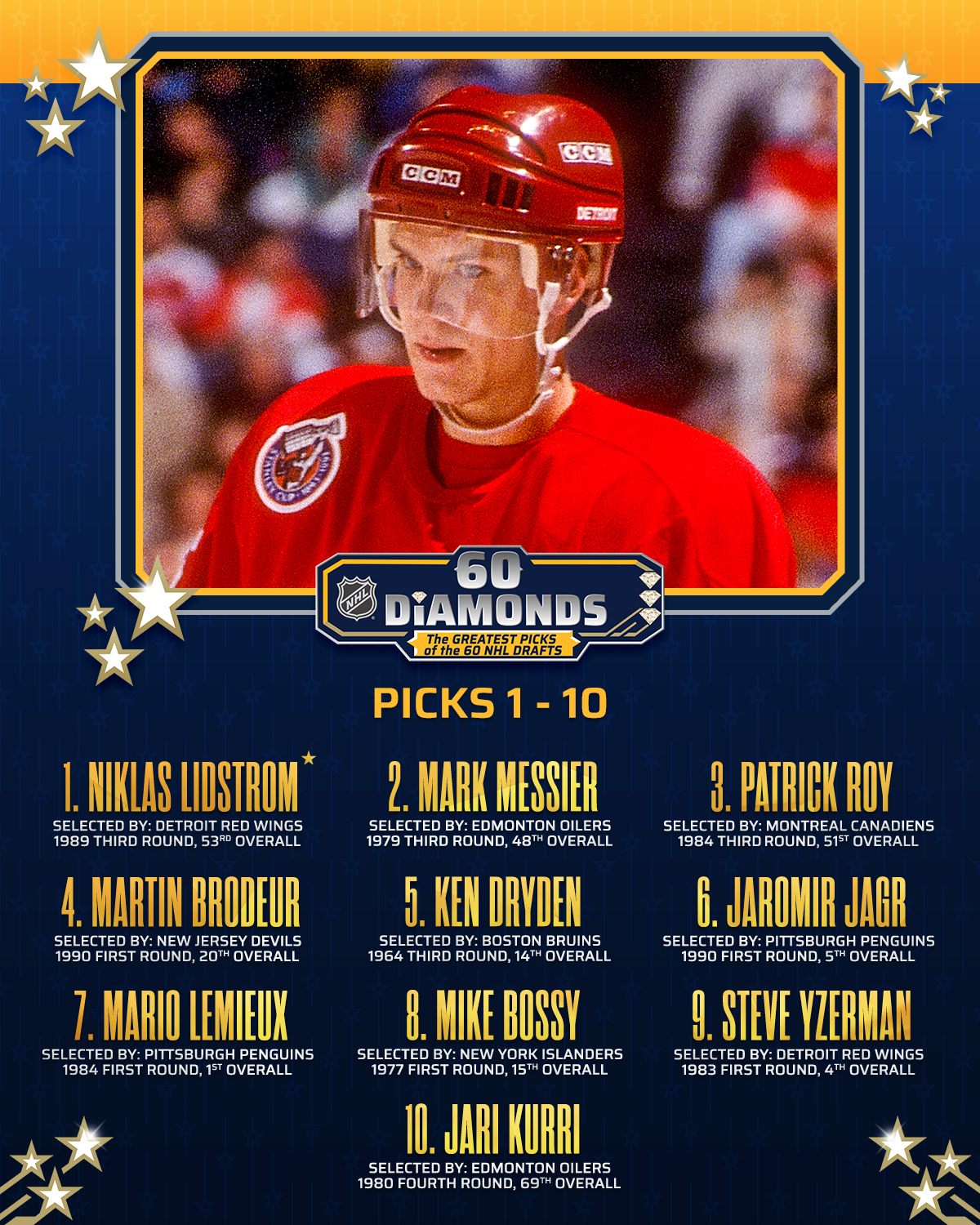
10. Jari Kurri, F (494)
Selected by: Edmonton Oilers, fourth round (No. 69), 1980
Kurri was one of two Hall of Famers selected by the Oilers in 1980, along with defenseman Paul Coffey (No. 6).
Kurri became an outstanding linemate for Wayne Gretzky during Edmonton’s championship dynasty. His 474 goals and 1,043 points are second all-time for the Oilers behind Gretzky (583 goals, 1,669 points), and Kurri was part of five Stanley Cup championships (1984, 1985, 1987, 1988, 1990).
His 601 goals in 17 NHL seasons are 20th in NHL history and second among Finland-born players, behind Teemu Selanne (684). Kurri was inducted into the Hockey Hall of Fame in 2001.
9. Steve Yzerman, F (496)
Selected by: Detroit Red Wings, first round (No. 4), 1983
Yzerman’s arrival ushered the Red Wings out of their “Dead Things” era. After reaching the Stanley Cup Playoffs twice in 17 seasons before he was selected, Yzerman got Detroit into the playoffs 20 times in his 22 NHL seasons, with Cup championships in 1997, 1998 and 2002, as well as another as a Red Wings executive in 2008. Yzerman is 10th in NHL history with 692 goals and seventh with 1,755 points, and was inducted into the Hockey Hall of Fame in 2009.
8. Mike Bossy, F (520)
Selected by: New York Islanders, first round (No. 15), 1977
Bossy ranks among the best goal scorers in NHL history, with his average of 0.76 goals per game first all-time among players with at least 150 games.
He had nine 50-goal seasons, tied with Wayne Gretzky and Alex Ovechkin for most all-time, and his 5 60-goal seasons are tied with Gretzky for the most.
He helped the Islanders win the Stanley Cup four straight seasons (1980-83), scored 61 goals in 72 playoff games during that stretch and won the Conn Smythe Trophy as most valuable player of the playoffs in 1982.
Bossy won the Calder Trophy in 1977-78 and the Lady Byng Trophy three times (1982-84, 1985-86) and was inducted into the Hockey Hall of Fame in 1991.
7. Mario Lemieux, F (526)
Selected by: Pittsburgh Penguins, first round (No. 1), 1984
Lemieux brought instant credibility to a Penguins team that had won one best-of-7 playoff series in their first 17 seasons.
He began his NHL career with six straight 100-point seasons, topped by 199 points (85 goals, 114 assists) in 1988-89.
He led the Penguins to back-to-back Stanley Cup championships in 1991 and 1992, then the following season, came back from Hodgkin’s lymphoma to win the scoring title with 160 points (69 goals, 91 assists) in 60 games.
Lemieux retired for the first time in 1997 and was immediately inducted into the Hockey Hall of Fame.
He came back four seasons later, now as Penguins owner, and remained a dominant player.
Lemieux retired for good in 2005-06 with 1,723 points (690 goals, 1,033 assists), eighth in NHL history, and his average of 1.88 points in 915 games is second all-time to Gretzky (1.92). He won the Art Ross Trophy six times (1987-89, 1991-93, 1995-97), the Hart Trophy three times (1987-88, 1992-93, 1995-96) and the Conn Smythe Trophy twice (1990-91, 1991-92).
“I can’t think of one player in the history of the NHL that has meant more to a franchise than Lemieux has meant to the Penguins. He’s one of the three greatest players in the game’s history, blending skill, speed, size (6-foot-4, 230 pounds) and strength in a way no one ever has. The Penguins were a moribund franchise before he arrived in 1984, and within eight years, they had two Stanley Cup championships and were an elite NHL team.
He also helped secure the Penguins’ future in Pittsburgh when he worked to find financing for PPG Paints Arena.
Off the ice, the Mario Lemieux Foundation has helped raise millions of dollars for cancer research and to help Pittsburgh-area families deal with the disease. To me, it was really easy to mark down Lemieux as the greatest NHL draft pick ever.” — Adam Kimelman, deputy managing editor
6. Jaromir Jagr, F (532)
Selected by: Pittsburgh Penguins, first round (No. 5), 1990
The ageless wonder arrived in time to help the Penguins win the Stanley Cup in his first two NHL seasons.
Jagr and Lemieux dominated the NHL scoring race, with one of the two winning the Art Ross Trophy seven straight seasons between 1994-95 and 2000-01. Jagr starred even without Lemieux to deflect attention, winning the scoring title four straight seasons (1997-01); the only player to win it more consecutive times is Gretzky (seven straight, 1980-87).
Jagr won the Hart Trophy in 1998-99, the Ted Lindsay Award as most outstanding player as voted by the NHL Players’ Association three times (1998-2000, 2005-06), and his 1,921 points (766 goals, 1,155) points are second all-time to Gretzky.
Jagr left the NHL in 2018, after playing 1,733 games in 24 seasons, but at age 51, had 14 points (five goals, nine assists) in 26 games with Kladno in the top league in the Czech Republic this season.
5. Ken Dryden, G (538)
Selected by: Boston Bruins, third round (No. 14), 1964
In the second-ever NHL draft, the six teams selected a total of 24 players, and Dryden was the only goalie chosen. The pick turned into a steal, but not for the Bruins, who traded Dryden to the Montreal Canadiens just 17 days after selecting him.
He turned pro in 1970-71, and after 33 games with the Montreal Voyageurs of the American Hockey League, Dryden made his NHL debut on March 14, 1971. He was the surprise starter for the Canadiens when the 1971 playoffs started but backstopped them to the Stanley Cup. It was the first of six championships for Dryden in his eight NHL seasons, including four straight from 1976-79.
He’s the only goalie in NHL history to win the Conn Smythe Trophy (1971) and Calder Trophy (1971-72) in back-to-back seasons, and he won the Vezina Trophy five times (1972-73, 1975-79).
Dryden went 258-57 with 74 ties and 46 shutouts in 397 games and was inducted into the Hockey Hall of Fame in 1983.
4. Martin Brodeur, G (593)
Selected by: New Jersey Devils, first round (No. 20), 1990
The Devils were in need of a goalie heading into the 1990 NHL Draft, but with the No. 11 pick, felt they still could get the player they wanted if they moved back.
A trade with the Calgary Flames allowed them to gain an extra second-round pick for moving down to No. 20, and waiting for them was Brodeur, who became the winningest goalie in NHL history during his 22 NHL seasons, all but seven games of it spent with the Devils.
Brodeur’s 691 wins are 140 more than second-place Patrick Roy (551), and he also holds NHL marks for games played by a goalie (1,266) and shutouts (125). He helped the Devils win the Stanley Cup three times (1995, 2000, 2003) and won the Vezina Trophy four times in a five-season span between 2002-03 and 2007-08.
Brodeur retired after seven games with the St. Louis Blues in 2014-15 and was inducted into the Hockey Hall of Fame in 2018.
“There may be a debate of who the best goalie of all time is, but there’s no debate that the Devils got a steal when they selected Brodeur.
The all-time wins leader wasn’t even the first goalie taken in the 1990 draft – that was Trevor Kidd at No. 11 by the Flames, who played 387 games and had 140 wins, never more than 22 in a season.
Brodeur won at least 30 games 14 times and has a packed trophy case, winning the Stanley Cup 3 times, the Vezina Trophy 4 times, and the Calder Trophy (1993-94).
But what stands out for me is his durability. He played at least 70 games 10 straight seasons (1997-2008), rarely got hurt, and even scored three goals (two regular season, one playoffs).” — David Satriano, staff writer
3. Patrick Roy, G (636)
Selected by: Montreal Canadiens, third round (No. 51), 1984
Roy’s statistics during his three seasons with Granby of the Quebec Major Junior Hockey League were unimpressive; his best season was a 4.44 goals-against average in 61 games in 1983-84.
But everything changed after the Canadiens sent him to Sherbrooke of the American Hockey League in 1984, where he mastered the butterfly style under goalie coach Francois Allaire.
Roy joined the Canadiens full-time in 1985-86, and as a 20-year-old rookie that season, backstopped Montreal to the Stanley Cup and won the Conn Smythe Trophy.
It was the first of four championships for Roy with the Canadiens (1986, 1993) and Colorado Avalanche (1996, 2001), three of which ended with him also winning the Conn Smythe (also 1993, 2001).
Roy also won the Vezina Trophy three times (1988-90, 1991-92), and he’s one of two goalies, along with Roberto Luongo, to win 200 games with two teams (Canadiens 289, Avalanche 262), and each team retired his No. 33.
The first goalie to 500 wins and 1,000 games, Roy was inducted into the Hockey Hall of Fame in 2006.
2. Mark Messier, F (677)
Selected by: Edmonton Oilers, third round (No. 48), 1979
The Oilers selected Hall of Famers with their first three NHL draft picks, with Messier chosen between defenseman Kevin Lowe in the first round (No. 21) and forward Glenn Anderson in the fourth round (No. 69).
Shifted from wing to center behind Gretzky, Messier was a physical force who bulled his way to four 40-goal seasons and six 100-point seasons. He helped the Oilers win the Stanley Cup five times, including in 1990 as captain.
But he cemented his legacy after his trade to the New York Rangers in 1991. He backed up his memorable guarantee of a victory in Game 6 of the 1994 Eastern Conference Final against the Devils with a hat trick, then helped the Rangers end a 54-year Cup drought in a seven-game win against the Vancouver Canucks in the Final. As captain of that Rangers team, he is the only person in NHL history to captain two teams to the Stanley Cup.
Messier retired in 2004, the second all-time to Gretzky, in points (1,887), and his 1,756 games played were second all-time to Gordie Howe (1,767). Messier was inducted into the Hockey Hall of Fame in 2007.
1. Nicklas Lidstrom, D (683)
Selected by: Detroit Red Wings, third round (No. 53), 1989
Lidstrom was nicknamed “the perfect human” by his teammates, and there are few that would argue. He was a steal, the 19th defensemen selected and the third in the third round, after Bob Kellogg (No. 48, Chicago Blackhawks) and Veli-Pekka Kautonen (No. 50, Calgary Flames), neither of whom played in the NHL.
Lidstrom played two additional seasons in his native Sweden after being selected but proved worth the wait. He had 60 points (11 goals, 49 assists) and was a plus-36 as a rookie in 1991-92, the first display of his all-around skill.
In the 1997 Stanley Cup Final, he and partner Larry Murphy helped shut down the Philadelphia Flyers’ Legion of Doom line of Eric Lindros, John LeClair and Mikael Renberg as Detroit won its first championship since 1955, and helped the Red Wings win the Cup again the following season.
In 2000-01, he won the Norris Trophy as the best defenseman for the first of 7 times; only Bobby Orr (8) won it more. Lidstrom won the Conn Smythe Trophy in 2002 when the Red Wings won the Cup, and in 2008, he became the first Europe-born captain to win the Cup.
Lidstrom won his 7th Norris Trophy at age 40 in 2010-11 and retired in 2012. He’s sixth all-time among NHL defensemen with 1,142 points (264 goals, 878 assists) and was a plus-450 in 1,564 games.
The Red Wings made the postseason in each of Lidstrom’s 20 NHL seasons, and he was inducted into the Hockey Hall of Fame in 2015.
“Imagine selecting a player in the third round who not only would go on to play more than 1,500 games, but win the Norris Trophy as the best defenseman in the NHL seven times (2000-03, 2005-08, 2010-11).
Lidstrom also was a 10-time First-Team NHL All-Star and helped the Red Wings win the Stanley Cup 4 times.
He did everything effortlessly — skating, first pass out of the defensive zone, quarterback the power play. You name it, Lidstrom did it. He also handled the captaincy in Detroit with dignity and grace for six seasons, highlighted by a championship in 2008.
To think he was part of a Red Wings draft class in 1989 that also included Mike Sillinger (No. 11), Bob Boughner (No. 32), Sergei Fedorov (No. 74), Dallas Drake (No. 116) and Vladimir Konstantinov (No. 221), it’s no wonder why Detroit senior vice president Jim Devellano is a member of the Hockey Hall of Fame in the builder’s category.” — Brian Compton, managing editor
Source: nhl.com
Discover more from CanucksBanter
Subscribe to get the latest posts sent to your email.