In Part 3, we look at the specific components that formed the identity and success of the 2008-2011 Canucks teams, identifying the key ingredients for replication by the present Canucks team.
Elite Offensive Firepower
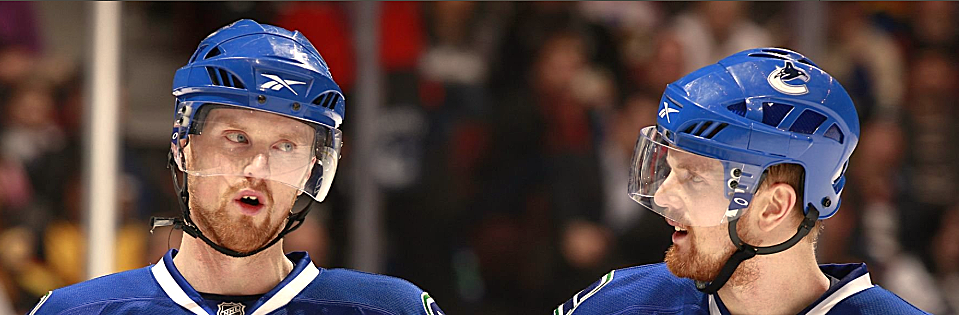
The offensive foundation of the 2008-2011 Canucks was laid by the interdependent duo of twins Henrik and Daniel Sedin.
Henrik’s 2010 Art Ross and Hart Trophy season (112 points) and Daniel’s 2011 Art Ross Trophy season (104 points) were the culmination of years of development.
Their success was not solely about their individual talent, but the symbiotic relationship between them and their linemates, most notably Alex Burrows.
They were not concerned with playing alongside other highly skilled players; instead, they sought hardworking and competitive teammates, a philosophy that led to the acquisition of players who fit their vision.
The team’s attack was not one-line-based or composed of two individuals, but was a balanced, multifaceted threat.
In addition to the elite playmaking of the Sedin line, the Canucks benefited from the Selke-caliber two-way game of Ryan Kesler, who scored 41 goals in 2010-11 and won the Selke Trophy for best defensive forward.
The combination of a predictable, elite top line, a powerful two-way second line, and a deep supporting cast made the team incredibly difficult to match up against.
The dependable scoring from multiple lines meant that if one line was shut down, others could still generate offense.
Defensive Stability and Goaltending Dominance
The defensive strength of the team was a hallmark of their 2010-11 Presidents’ Trophy season.
Vancouver was anchored by Roberto Luongo, a franchise goaltender who was a perennial Vezina Trophy finalist.
Luongo’s elite performance was complemented by a formidable backup in Cory Schneider, which allowed for proper load management and ensured a high level of play in the crease every night.
This 1A/1B goaltending tandem was a key competitive advantage that few other teams in the league could replicate.
While there were key defensive players like Alex Edler, who averaged nearly 25 minutes of ice time per game in the 2011 playoffs, the team’s success was rooted in a system-first approach.
Under coach Alain Vigneault, the team’s defensive structure was sound, and the emphasis on fatigue management and conditioning ensured players were able to execute the system consistently over an 82-game season.
This collective focus on a shared system, rather than reliance on a single standout defenseman, provided the stability necessary to support their aggressive offensive play.
Beyond The Numbers: Leadership, Culture, and Consistency
Beyond the numbers, the defining characteristics of this era were the team’s culture and leadership.
The Sedin twins were not born superstars; they “knew they had to improve” and “pushed every year to get better”. This relentless pursuit of excellence became a top-down cultural force that permeated the entire locker room.
The Sedins’ conduct and accountability, even after a loss, became the “blueprint for the entire franchise” and arguably the most significant factor in the team’s long-term success.
The Canucks organizational success wasn’t haphazardly put together but the result of a long-term vision.
General managers Brian Burke, Dave Nonis, and Mike Gillis built the team with the Sedins as the long-term core.
This was not a quick fix; it was a decade-long project that demonstrated the value of patience in team building, a philosophy that is a stark contrast to the modern “win-now” approach often seen in professional sports.
Key Player Contributions: 2008-2011 Era
Player
Position
Key Role
Notable Stats (08-11)
Awards & Recognition
Henrik Sedin
Center
Offensive Leader, Captain
2009-10: 112 Pts (29G, 83A)
2010 Hart, Art Ross Trophies
Daniel Sedin
Left Wing
Offensive Catalyst
2010-11: 104 Pts (41G, 63A)
2011 Art Ross Trophy
Roberto Luongo
Goalie
Franchise Goaltender
2010-11: 38 W, 2.11 GAA,.928 SV%
2011 William Jennings Trophy
Ryan Kesler
Center
Elite Two-Way Forward
2010-11: 41 G, 73 Pts
2011 Selke Trophy
Next up, the 2025-26 Canucks: A Contemporary Roster Analysis, the projected roster and strategic direction of the 2025-26 Canucks.
By Andrew Phillip Chernoff and Zachary Oliver Burnham
October 3, 2025
The Blueprint of Success: A Review of the 2008-2011 Canucks Seasons
We begin this topic by trying to determine where the current Canucks team fits in relation to the 2008-2011 Vancouver Canucks teams. The answers will indicate where the present Canucks team stands. By examining the statistical information and analyzing the evolution of the Vancouver Canucks over the three seasons in question, we provide the foundational data for our comparative analysis.
The Ascendancy of a Core: The 2008-09 Season
The 2008-09 campaign was a foundational step in the team’s development, marking a significant stride from a retooling franchise to a legitimate contender.
The team finished with a regular season record of 45-27-10, accumulating 100 points, which was good enough to finish 1st in the Northwest Division.
Statistically, the team was strong, though not yet a league leader. They ranked 11th out of 30 teams with 243 Goals For and 7th with 213 Goals Against.
A key performance metric, the Simple Rating System (SRS), which adjusts for strength of schedule, placed the Canucks 6th in the league with a rating of 0.30.
Their Strength of Schedule (SOS) was -0.02, ranking 22nd, indicating a slightly easier schedule than many of their contemporaries.
The team’s playoff run was a crucial, unfortunately ending with a six-game loss to the Chicago Blackhawks in the Conference Semi-Finals.
“Taking It Up A Notch”: The 2009-10 Season
The lessons of the previous year were evident in the 2009-10 season, as the Canucks elevated their play and solidified their status as an elite offensive force.
The team improved their record to 49-28-5, earning 103 points and once again securing the Northwest Division title.
Their offensive production saw a dramatic increase, ranking 2nd in the league with 268 Goals For, while their defensive stability held steady, allowing 218 Goals Against (11th overall).
This statistical improvement was reflected in their SRS, which rose to 0.60 (4th in the league), and their SOS was nearly average at -0.01 (15th).
Despite a statistically superior regular season, the playoff narrative remained the same, with the team losing again to the Chicago Blackhawks in the Conference Semi-Finals.
The dramatic leap in offensive production can be directly attributed to the maturation of the team’s core, particularly Henrik Sedin’s remarkable performance.
His Art Ross and Hart Trophy-winning season, where he amassed 112 points , was the statistical manifestation of the team’s new offensive identity.
This season proved that the long-term investment in the Sedin twins was paying off, as they evolved from highly skilled players into franchise-defining leaders.
The second consecutive playoff loss to Chicago, however, underscored a psychological and strategic hurdle the team had yet to overcome.
It demonstrated that metrics alone were not enough and that a mental and physical breakthrough was required to defeat their rivals.
This failure served as the final piece of motivation needed to prepare for the subsequent season.
The Pinnacle Of Success Minus The Stanley Cup : The 2010-11 Season
The Canucks amassed a franchise-best record of 54-19-9, earning a league-best 117 points and the Presidents’ Trophy.
They achieved a level of dominance unseen in the franchise’s history, ranking 1st in the league in both Goals For (258) and Goals Against (180). Their SRS, a measure of their overall dominance, was a league-leading 0.87. A notable piece of context, however, is their Strength of Schedule, which was the league’s weakest at -0.07 (30th).
This did not negate their performance but did provide nuance, suggesting their record was buoyed by an easier schedule, particularly in their division.
This season culminated in a deep playoff run that saw them finally defeat the Chicago Blackhawks in the first round before falling in Game 7 of the Stanley Cup Final to the Boston Bruins.
The team’s league-leading defensive record was not just a product of strong defensemen but was rooted in elite goaltending.
The goaltending tandem of Roberto Luongo and Cory Schneider won the William Jennings Trophy for the fewest goals against in the league. Luongo, in particular, had a career-defining season, leading the league in wins (38) and setting a franchise record with a 2.11 GAA and a.928 save percentage.
This was the final ingredient that transformed a high-scoring, good defensive team into a historically great one.
The goaltending was the linchpin that made their aggressive, possession-based style possible by providing unwavering security at the back end.
Summary of Vancouver Canucks 2008-2011 Season Performance
Season
Record (W-L-OTL)
Points
Division Rank
Playoff Result
SOS
SRS
2008-09
45-27-10
100
1st
Lost Conference Semi-Finals
-0.02
0.30
2009-10
49-28-5
103
1st
Lost Conference Semi-Finals
-0.01
0.60
2010-11
54-19-9
117
1st
Lost Stanley Cup Final
-0.07
0.87
Highlights of Canucks 2008-2011 Teams
In review, the Vancouver Canucks had a very successful run from 2008 to 2011, culminating in their appearance in the Stanley Cup Finals in2011. Here are more highlights:
2008-09 Season: The Canucks won the Northwest Division title and Roberto Luongo won the William M. Jennings Trophy for fewest goals against.
2009-10 Season: Henrik Sedin won the Art Ross Trophy as the league’s leading scorer and the Hart Trophy as the NHL’s most valuable player.
2010-11 Season: The Canucks won the Presidents’ Trophy for the best record in the NHL and reached the Stanley Cup Finals, ultimately losing to the Boston Bruins in seven games. This season saw many exciting moments, including:
A thrilling playoff series win against their rivals, the Chicago Blackhawks, after overcoming a 3-0 series deficit.
Ryan Kesler’s dominant performance throughout the playoffs, leading the team in goals.
Kevin Bieksa’s overtime goal in Game 5 of the Western Conference Finals to send the Canucks to the Stanley Cup Finals
This period was a high point in the Canucks’ recent franchise history, featuring a talented core of players, including the Sedin twins, Ryan Kesler, Roberto Luongo, and Alex Burrows.
Off-Ice Challenges:
High expectations and pressure: As the team got better, the pressure to win intensified, especially in a hockey-mad city like Vancouver. This could be a heavy burden for the players.
Media scrutiny: The Vancouver media market is known for being intense, and the Canucks faced constant scrutiny and criticism, which could be a distraction.
2011 Stanley Cup Riot: Although this occurred after the Finals loss, the riot cast a shadow over the team’s accomplishments and created a difficult atmosphere in the city.
Their ability to overcome adversity is a testament to their talent, resilience, and determination.
To discuss talent, resilience, and determination in general terms is one thing, but the 2008-2011 Canucks truly embodied those qualities. Here are some concrete examples:
Talent:
The Sedin twins: Henrik and Daniel Sedin were at the peak of their powers, showcasing incredible playmaking ability, vision, and hockey IQ. Henrik’s Art Ross and Hart Trophy win in 2010 solidified his status as one of the league’s elite. They consistently elevated their linemates and made everyone around them better.
Ryan Kesler: A dominant two-way force, Kesler was a shutdown center who could also score clutch goals. His performance in the 2011 playoffs, particularly against his rival Jonathan Toews, was remarkable.
Roberto Luongo: Despite facing criticism, Luongo was a world-class goaltender who stole games for the Canucks. His calmness and athleticism provided a solid foundation for the team’s success.
Resilience:
Overcoming the 3-0 deficit against Chicago: In the 2011 playoffs, the Canucks were down 3-0 to the Blackhawks and facing elimination. They showed incredible resilience by winning the next three games, forcing a Game 7, and ultimately winning the series in overtime. This comeback demonstrated their mental toughness and refusal to give up.
Bouncing back from injuries: Key players like Daniel Sedin and Ryan Kesler battled injuries throughout the playoffs but continued to contribute. The team showed resilience by adapting to the lineup changes and finding ways to win despite missing key players.
Determination:
Henrik Sedin’s leadership: As captain, Henrik led by example with his tireless work ethic and dedication to the game. He was a calming presence and always put the team first, inspiring his teammates to strive for excellence.
Quest for the Stanley Cup: The Canucks were driven by a burning desire to win the Stanley Cup, which had eluded the franchise for so long. This determination was evident in their relentless effort and commitment to each other throughout the season and playoffs.
Those are just a few examples of the talent, resilience, and determination that defined the 2008-2011 Vancouver Canucks.
Coaching and Management
The coaching and management of the Vancouver Canucks from 2008-2011 played a crucial role in the team’s success.Here’s how they contributed:
Management:
Building a strong core: General Manager Mike Gillis assembled a talented roster through shrewd drafting (like Cody Hodgson and Cory Schneider), trades (acquiring Ryan Kesler, Alex Burrows, Kevin Bieksa), and free agency (signing Manny Malhotra and Dan Hamhuis). This created a balanced team with scoring, defense, and goaltending.
Adding depth players: Gillis recognized the importance of depth, acquiring key role players like Raffi Torres and Chris Higgins to contribute in different situations.
Providing stability: Gillis and ownership provided a stable environment, allowing the team to develop chemistry and continuity over multiple seasons.
Coaching:
Alain Vigneault’s system: Coach Vigneault implemented an up-tempo, offensive-minded system that maximized the skill of the Sedin twins and other offensive players. He also emphasized defensive responsibility and puck possession.
Developing young players: Vigneault and his coaching staff fostered the development of young players like Jannik Hansen and Alex Edler, who became key contributors.
Creating a winning culture: Vigneault instilled a strong work ethic and a belief in the team’s ability to win. He fostered a positive and supportive environment that allowed players to thrive.
Adapting to opponents: The coaching staff showed tactical flexibility, adjusting their strategies to exploit opponents’ weaknesses and counter their strengths.
Combined efforts:
Strong communication and collaboration: The management and coaching staff worked closely together to identify needs, make roster moves, and implement game plans. This created a unified and focused team.
Emphasis on fitness and conditioning: The Canucks were known for their strong conditioning, which allowed them to play an intense and demanding style. This was a result of the combined efforts of the coaching and training staff.
By combining innovative management, effective coaching, and a focus on player development, the Canucks created a winning team that was well-prepared to compete for the Stanley Cup.
In my article on September 30, 2024, I wrote, “The 2024-25 season should let Canucks fans know just where their team is on that road to the Stanley Cup Final to play for the professional sports ultimate championship trophy. We all know how that turned out.
At least Canucks ownership, management, the players, and the fanbase can’t say they don’t know what it will take to win: everything they’ve got and more, including puck luck.
Next up, we look at the specific components that formed the identity and success of the 2008-2011 Canucks teams, identifying the key ingredients for replication.