By Andrew Phillip Chernoff and Zachary Oliver Burnham
October 4, 2025
In Part 2 of “The 2008-2011 Canucks Teams of The Sedins Era: To Be A Playoff Contender” we reviewed the 2008-2011 Canucks seasons (the Sedins Era) in “Analyzing the Canucks: 2008-2011 Seasons Uncovered“.
In Part 3, we look at the specific components that formed the identity and success of the 2008-2011 Canucks teams, identifying the key ingredients for replication by the present Canucks team.
Elite Offensive Firepower
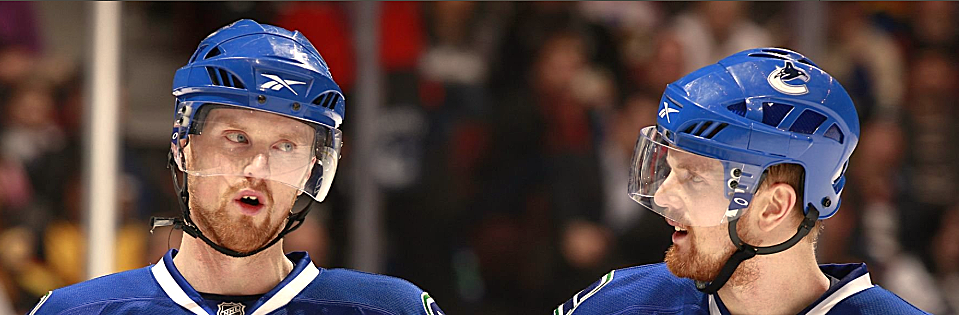
The offensive foundation of the 2008-2011 Canucks was laid by the interdependent duo of twins Henrik and Daniel Sedin.
- Henrik’s 2010 Art Ross and Hart Trophy season (112 points) and Daniel’s 2011 Art Ross Trophy season (104 points) were the culmination of years of development.
- Their success was not solely about their individual talent, but the symbiotic relationship between them and their linemates, most notably Alex Burrows.
- They were not concerned with playing alongside other highly skilled players; instead, they sought hardworking and competitive teammates, a philosophy that led to the acquisition of players who fit their vision.
The team’s attack was not one-line-based or composed of two individuals, but was a balanced, multifaceted threat.
- In addition to the elite playmaking of the Sedin line, the Canucks benefited from the Selke-caliber two-way game of Ryan Kesler, who scored 41 goals in 2010-11 and won the Selke Trophy for best defensive forward.
- The combination of a predictable, elite top line, a powerful two-way second line, and a deep supporting cast made the team incredibly difficult to match up against.
- The dependable scoring from multiple lines meant that if one line was shut down, others could still generate offense.
Defensive Stability and Goaltending Dominance
The defensive strength of the team was a hallmark of their 2010-11 Presidents’ Trophy season.
- The Canucks won the William Jennings Trophy for fewest goals against in the league, a testament to their overall defensive structure and elite goaltending.
- Vancouver was anchored by Roberto Luongo, a franchise goaltender who was a perennial Vezina Trophy finalist.
- Luongo’s elite performance was complemented by a formidable backup in Cory Schneider, which allowed for proper load management and ensured a high level of play in the crease every night.
- This 1A/1B goaltending tandem was a key competitive advantage that few other teams in the league could replicate.
While there were key defensive players like Alex Edler, who averaged nearly 25 minutes of ice time per game in the 2011 playoffs, the team’s success was rooted in a system-first approach.
Under coach Alain Vigneault, the team’s defensive structure was sound, and the emphasis on fatigue management and conditioning ensured players were able to execute the system consistently over an 82-game season.
- This collective focus on a shared system, rather than reliance on a single standout defenseman, provided the stability necessary to support their aggressive offensive play.
Beyond The Numbers: Leadership, Culture, and Consistency
Beyond the numbers, the defining characteristics of this era were the team’s culture and leadership.
- Described as “talented, bold and brash, with personality up and down the roster,” the team’s identity was shaped by the relentless work ethic of its leaders.
- The Sedin twins were not born superstars; they “knew they had to improve” and “pushed every year to get better”. This relentless pursuit of excellence became a top-down cultural force that permeated the entire locker room.
- The Sedins’ conduct and accountability, even after a loss, became the “blueprint for the entire franchise” and arguably the most significant factor in the team’s long-term success.
The Canucks organizational success wasn’t haphazardly put together but the result of a long-term vision.
- General managers Brian Burke, Dave Nonis, and Mike Gillis built the team with the Sedins as the long-term core.
- This was not a quick fix; it was a decade-long project that demonstrated the value of patience in team building, a philosophy that is a stark contrast to the modern “win-now” approach often seen in professional sports.
Key Player Contributions: 2008-2011 Era
| Player | Position | Key Role | Notable Stats (08-11) | Awards & Recognition |
| Henrik Sedin | Center | Offensive Leader, Captain | 2009-10: 112 Pts (29G, 83A) | 2010 Hart, Art Ross Trophies |
| Daniel Sedin | Left Wing | Offensive Catalyst | 2010-11: 104 Pts (41G, 63A) | 2011 Art Ross Trophy |
| Roberto Luongo | Goalie | Franchise Goaltender | 2010-11: 38 W, 2.11 GAA,.928 SV% | 2011 William Jennings Trophy |
| Ryan Kesler | Center | Elite Two-Way Forward | 2010-11: 41 G, 73 Pts | 2011 Selke Trophy |
Next up, the 2025-26 Canucks: A Contemporary Roster Analysis, the projected roster and strategic direction of the 2025-26 Canucks.
Until next time, hockey fans