
Canucks Face Tough Challenge Against Avalanche Tonight
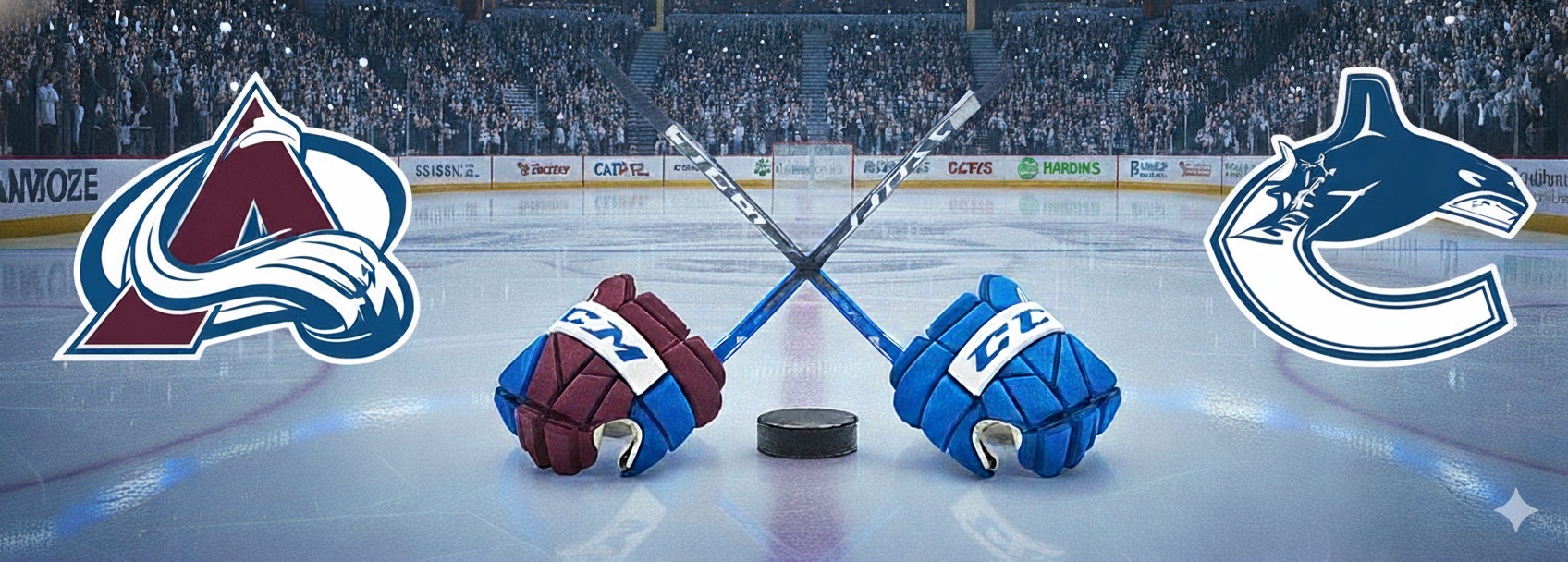
Graphic featuring the logos of the Colorado Avalanche and Vancouver Canucks, with crossed hockey sticks and a puck on an ice rink.

By Andrew Phillip Chernoff | CanucksBanter

November 09, 2025

The Colorado Avalanche are set to visit the Vancouver Canucks at Rogers Arena tonight, Sunday, November 9, 2025, at 07:00 PM PST.

This is a matchup of two teams playing on the second night of a back-to-back, which could impact the energy levels.

This contest pits an elite, high-momentum offensive engine against a structurally compromised defensive unit.

The Colorado Avalanche enter this contest holding decisive advantages in, roster depth, special teams execution, and the crucial goaltending matchup.

The Avalanche are expected to control the pace of the game, utilizing their depth and their power-play opportunities against the Canucks’ struggling penalty kill.

The Colorado Avalanche (9-1-5, 23 points) enters this matchup demonstrating systemic dominance, holding the league’s best record and the highest overall competitive ranking. Conversely, the Vancouver Canucks (8-8-0, 16 points) are grappling with pronounced defensive vulnerabilities and a critical goaltending crisis, compounded by the back-to-back (B2B) schedule for both clubs.   

TeamRecordRecent
(Last Game)
Key
Players
Goaltending Situation
Colorado Avalanche9-1-5 (23 Pts, NHL Best)W 9-1 vs. Edmonton Oilers (on Saturday)Nathan MacKinnon (League-leading points/goals), Cale MakarMackenzie Blackwood is the expected starter (second straight back-to-back start).
Vancouver Canucks8-8-0 (16 Pts)W 4-3 vs. Columbus Blue Jackets (on Saturday)Evander Kane, Brock Boeser, Quinn HughesJiri Patera is the unconfirmed but likely starter as Thatcher Demko is getting maintenance rest.

Key Storylines

  • Avalanche Offensive Juggernaut: Colorado is coming off a massive 9-1 win and leads the league in points. The offense is firing on all cylinders, led by Nathan MacKinnon (on an 8-game point streak) and Cale Makar. They’re a high-scoring team (2nd in Goals For/Game) with top-tier defense (1st in Goals Against/Game) and penalty kill (4th).
  • Canucks’ Tough Task: Vancouver managed a much-needed win last night against Columbus but now faces arguably the toughest team in the league. They will need to bring their “A-game” to stop the Avalanche’s powerful offense, which is a major challenge, especially with a likely backup goalie starting.
  • Goaltending Edge: The Canucks are managing the workload of star goalie Thatcher Demko (who is not expected to play), likely giving the nod to either Kevin Lankinen or the recalled Jiri Patera. The Avalanche are also playing their backup, Mackenzie Blackwood, due to the back-to-back situation.
    • Thatcher Demko, who previously engineered a 3-0 shutout against the Avalanche last season , will not be available.
    • Demko is being held out of the lineup due to “preventative maintenance” or an undisclosed injury, having only participated in skating drills on Saturday morning but not dressing for the game. 
    • His absence entirely nullifies Vancouver’s single most important advantage—the capacity for a goaltender to single-handedly steal a game against superior competition.

Injury Notes

  • Avalanche: Key players out include Samuel Girard (upper body, day-to-day) and Joel Kiviranta (lower body, indefinitely). Logan O’Connor (hip) is nearing a return.
  • Canucks: Vancouver’s depth has been significantly compromised by multiple injuries affecting their middle-six forward core and defense.
    • Key players currently out include Nils Höglander (Long-Term Injured Reserve due to an ankle injury sustained in the preseason), Filip Chytil (Injured Reserve due to concussion protocol), Jonathan Lekkerimäki (Injured Reserve, upper body), and Teddy Blueger (Injured Reserve, lower body). 
    • The absence of these players strains the team’s ability to maintain pace against high-tempo opponents and necessitates greater reliance on the top lines.

Avalanche Strengths and Key Players

The Avalanche have only one regulation loss this season and average nearly four goals per game (3.93). Cale Makar continues his hot streak with points in nine consecutive games, and Colorado’s depth has shown with multiple players contributing offensively in recent wins. Their defense is equally impressive, ranking at the top of the league, allowing just 2.40 goals per game, and holding the best penalty kill percentage at 90.5%.

Canucks Trends and Standouts

The Canucks, meanwhile, swept the season series against Colorado last year but have struggled recently, conceding four or more goals in three of their last four matches. Their penalty kill and defensive play have been among the weakest in the NHL—ranking 29th on the penalty kill and 25th in goals allowed per game. Conor Garland leads Vancouver in scoring this season with 12 points, followed by Elias Pettersson and Kiefer Sherwood.

Some Thoughts

The back-to-back games marginally relieve the certainty of a high-scoring game but does little to change Colorado’s fundamental competitive advantage.

The special teams matchup represents the most significant tactical vulnerability for the Vancouver Canucks in this contest. Vancouver’s Penalty Kill (PK%) is struggling severely, running at a highly concerning 69.81%. Vancouver’s Power Play (PP%) of 18.00% is statistically unacceptable for an NHL team hoping to make the 2026 NHL playoffs.

Team statistics comparison between the Colorado Avalanche and Vancouver Canucks for the regular NHL season, showing key metrics such as power play percentage, penalty kill percentage, face-off percentage, goals for per game, and goals against per game.

Despite strong performances from the core forwards, the depth makes offensive production difficult. The projected lines for Vancouver feature notable movement, particularly in the top six, but the multiple injuries affecting their middle-six forward core have limited the Canucks ability to compete.

It is, what it is.

Vancouver played an outstanding game last night, considering the “cards they’ve been dealt”, and they hung on for an outstanding win to please the home crowd and the Canucks fan base.

With all the adversity the Canucks are facing on paper, let’s hope for a similar game against the Avalanche tonight and put our collective energies behind them to urge them on.

The game hasn’t been written yet, may the Canucks provide another glorious ending!

Until next time, hockey fans

Source: nhl.com

Canucks 2025 Training Camp: The Main Event – Day 3: Blue and White Scrimmage

Vancouver Canucks 2025 Training Camp logo featuring the team's orca mascot, mountain graphics, and the location 'Penticton BC'.

By Andrew Phillip Chernoff

September 20,, 2025

Day 3 of the Vancouver Canucks 2025 training camp was held at the South Okanagan Events Centre in Penticton. This day marked a critical point of the training camp. The focus shifted from foundational skill work to competitive, game-like evaluation.

The main event was the highly anticipated Blue vs. White scrimmage. It was the first actual test of the new coaching staff’s systems. The game provided a high-stakes platform for players vying for a spot on the NHL team’s 23-man roster.

Team White secured a 4-1 victory. However, the final score was secondary. The underlying narratives and individual performances that emerged were more important.

The Blue-White scrimmage on Saturday served as the primary assessment tool for players aiming to make the roster. It simulated a game environment. It tested a player’s ability to make quick reads and other things presented in practice sessions. The event evaluated how players handle pressure and apply skills in a chaotic setting.

The scrimmage was streamed. This highlighted its importance to the organization and the fan base. It was the first live showcase of the team’s talent and new tactical system. The scrimmage was a definitive pass/fail test for many players. The pre-scrimmages preview and coaching sessions earlier in training camp identified several players. Their performance would be particularly scrutinized.

The Canucks entered camp with 59 players. They must cut 36 of them or place them on injured reserve. This is needed to reach the NHL roster limit of 23 by October 6. The strategic realities of player contracts and waiver eligibility control this intense competition.

The camp’s central themes, going into the Blue-White scrimmage game, were multi-faceted:

  • Establishing a new coaching system is the first step, followed by evaluating the readiness of key roster players. Most critically, the assessment of the readiness of a deep prospect pool.
  • The Canucks will enter this season with a different look and a stated goal to develop their organizational depth. This philosophy was on full display in the composition of the scrimmage rosters.  

Prioritizing internal evaluation and team-building over public relations and media availabilities is to be expected. This happens after putting the training camp participants under the microscope. This approach is consistent with Foote’s emphasis on building relationships and cultivating a strong leadership group.

Team White’s Dominance in the Blue & White Scrimmage

The high-intensity affair was structured with two 25-minute halves. This allowed for a brisk pace. It also encouraged heightened physical play from the outset. The team’s lineup was split into two distinct squads. It showcased the established stars. It also included a mix of prospects and roster hopefuls.

Team White’s forward group featured the projected top line of Jake DeBrusk, Elias Pettersson, and Brock Boeser. The second line consisted of the breakout trio of Arshdeep Bains, Braeden Cootes, and Kiefer Sherwood. The defensive pairings had Filip Hronek alongside Quinn Hughes. There was also a third pairing with Elias Pettersson (the defenceman) and Victor Mancini.

Team Blue countered with a high-potential trio of Evander Kane, Filip Chytil, and Jonathan Lekkerimäki. The defense included the pairing of Tyler Myers and Marcus Pettersson. Guillaume Brisebois and Joe Arntsen rounded out the blue line.

The goaltending duties were divided among the teams. Thatcher Demko and Nikita Tolopilo played for Team White. Kevin Lankinen and Ty Young handled the crease for Team Blue.

The scoring summary of the scrimmage highlighted Team White’s opportunistic play and the effectiveness of their depth.

  • Kiefer Sherwood opened the scoring by burying a rebound after a key play initiated by Braeden Cootes and Arshdeep Bains.
  • The second goal resulted from relentless forechecking. Bains and Sherwood combined to force a turnover from Quinn Hughes. Bains scored on a subsequent rush.
  • Vilmer Alriksson extended the lead to 3-0. He capitalized on a giveaway by Evander Kane. Alriksson fired a shot past Ty Young.
  • Team Blue’s lone goal came from Teddy Blueger, who displayed excellent technique to roof the puck past Nikita Tolopilo.
  • The final goal was an empty-netter by Brock Boeser. It was sealed after Elias Pettersson outworked Filip Hronek behind the net. Boeser did the rest to clinch the game.

To Help Make Them the Best They Can Be, To Help Us Be The Best

Canucks management, along with Head Coach Adam Foote and his assistant coaches, have a strategic organizational focus. It is designed to empower Canucks veterans, new Canucks, prospects, and invited players that came to training camp. They encourage accountability among themselves. Players push each other to strive for a higher level of play through renewed spirit and structure. This approach aims for a strong start to their upcoming seasons. It is applicable whether the end up in the Junior leagues, NCAA, Abbotsford, Kalamazoo, or the NHL.

The most significant storyline centers on Elias Pettersson. He is working to bounce back from what he called an unsatisfying season.

The Canucks have believed that Pettersson’s struggles last season were a correctable issue. They thought it was related to conditioning and buy-in. The onus was placed on the player to deliver. Meanwhile, he received the full backing of the team’s leadership.

Pettersson’s performance in the scrimmage was a tangible, on-ice confirmation of this renewed commitment. He outworked Filip Hronek to create a goal for Brock Boeser.

The projected top line of DeBrusk-Pettersson-Boeser is also under an intense spotlight.

This trio represents the organization’s primary effort. They aim to build an elite scoring line. They also want to address the team’s offensive challenges from last season. The players themselves have acknowledged the need for better performance. Boeser admitted that the first line “wasn’t making a difference many nights” in the middle of last season.

The success of this line is a high-stakes variable for the Canucks’ season. If they can perform to their potential, the team is in a better position. They can then contend for a playoff spot.

The Proving Ground: Roster Competitors and Bubble Players

Filip Chytil

The speedy center was consistently cited as a “standout” during the first few days of camp. His performance is particularly significant. It addresses a major organizational need. The Canucks missed the playoffs by six points last season. Their most glaring roster gap was the lack of a reliable second-line center.

His quick chemistry with linemates Evander Kane and Jonathan Lekkerimäki has further solidified his position as the presumptive second-line center.

Forward Line of Kiefer Sherwood, Arshdeep Bains, 2025 1st rd pick Braeden Cootes

  • Sherwood is a fan favourite described as a “gem” and “big game player.” He played a central role in two of Team White’s goals.
  • His linemate, Arshdeep Bains, proved in the scrimmage that his playoff success can translate to high-pressure situations.
  • The duo’s relentless forechecking led to a goal against a player of Quinn Hughes’ calibre. This play visually confirmed General Manager Patrik Allvin’s stated philosophy of fostering a “pack mentality” among the organization’s young players.
  • Cootes has had an intense camp despite his young age. He “hasn’t looked out of place” while skating alongside two players with NHL experience. His presence on a line with players competing for NHL spots is a clear organizational statement.
  • They are giving him a legitimate chance to compete with pros. He is expected to be sent back to the WHL. However, he can play some games to start the season. This will happen if he continues to impress the Canucks coaches and management.

Waiver-Eligible Vs Waiver-Exempt Players

The dynamic between waiver-eligible and waiver-exempt players is the single most important factor shaping the roster bubble. 

  • The team can send waiver-exempt players like Max Sasson and Jonathan Lekkerimäki to the AHL “with no consequence”. 
  • Sending down a waiver-eligible player—such as Arshdeep Bains, Aatu Räty, Linus Karlsson, or Nils Åman—carries a risk. The risk is losing them for free on the waiver wire.
  • This creates a more intense “bubble” for the waiver-eligible players. Their battle is not just against other prospects, but against the organizational imperative to retain valuable assets. 

The scrimmage was the waiver-exempt’s single most significant opportunity. It was a chance to prove they are too valuable to lose. They must make the opening night roster and stay. This puts them under more pressure than their waiver-exempt peers in making the NHL club.

The Long and Short of It

Day 3 of training camp was the first significant test for the Vancouver, and it revealed the high stakes of their roster decisions:

  • The battle for a roster spot is far from over. In the next 18 days, 36 players need to be cut or placed on injured reserve.
  • The team’s management makes complex decisions based on data. These decisions are influenced by on-ice performance. They are also affected by the strategic reality of waiver eligibility. 
  • The final roster will include established veterans. It will also have new additions. Additionally, the select few prospects who seized their opportunity will be part of it.
  • The scrimmage was just the first step in a high-stakes preseason. Every practice and game will be a final audition.
  • The ultimate success of the 2025-26 season depends on the right combination of top-tier talent. It also requires emerging prospects and a renewed sense of purpose and leadership. The events of Day 3 were a significant first test in this crucial process.

The Vancouver Canucks will put their new tactical identity to the test again.

They open their 2025 preseason tomorrow against their Pacific Northwest rivals, the Seattle Kraken. The game starts at 5 pm in Seattle.

Until next time, hockey fans

P.S.: Scrimmage Rosters from Blue-White game:

Scrimmage rosters for Team Blue and Team White during the Vancouver Canucks 2025 training camp, listing player names and numbers.