

By Andrew Phillip Chernoff | CanucksBanter
March 4, 2026
Set a spell and let us take a long, hard look at the state of hockey in British Columbia as the calendar turns toward the most frantic window of the NHL season.
Y’all come back now, because the narrative surrounding tonight’s clash between the Vancouver Canucks and the Carolina Hurricanes is less about the two points on the line and more about the structural dismantling of a franchise that has reached its statistical and organizational lowest point.
At Rogers Arena tonight, the air is thick with the scent of “roster management” and the impending March 6 trade deadline, a date that serves as a looming “heads will roll” ultimatum for a management team currently in the midst of an agonizingly public “facelift” of the roster.
The Vancouver Canucks enter tonight’s contest with a record of 18 wins, 35 losses, and 7 overtime defeats, totaling a meager 43 points that leaves them firmly in the basement of the Pacific Division and 32nd overall in the league.
The recent 6-1 humiliation at the hands of the Dallas Stars served as a stark reminder of the talent disparity between the league’s elite and a roster currently being treated as a liquidation sale by General Manager Patrik Allvin and President of Hockey Operations Jim Rutherford.
This is not merely a losing streak; it is a six-game skid that has stripped away any remaining illusions of competitiveness, forcing the “FAR” management triumvirate—Foote, Allvin, and Rutherford—to pivot from a “retool” to an explicit, painful rebuild.
Tyler Myers Traded To Dallas Stars
Vancouver Canucks General Manager Patrik Allvin announced today that the club has acquired a second-round pick in the 2027 NHL Draft and a fourth-round pick in the 2029 NHL Draft from the Dallas Stars in exchange for defenceman Tyler Myers. The Canucks will also retain 50% of Myers’s salary.
The Evander Kane and Teddy Blueger Rental Market
Beyond the blue line, the “UFA Clearance” is in full effect. Evander Kane and Teddy Blueger are widely expected to be moved before Friday’s 3:00 PM ET deadline.
- Kane, acquired to provide the “grit” and scoring presence lost in previous cycles, has found himself on the block as management seeks to purge “unsuccessful roster additions” and clear cap space. Despite a declining production rate and a full NMC that complicates matters, interest from Western Conference contenders remains high for a player of his physicality and secondary scoring potential.
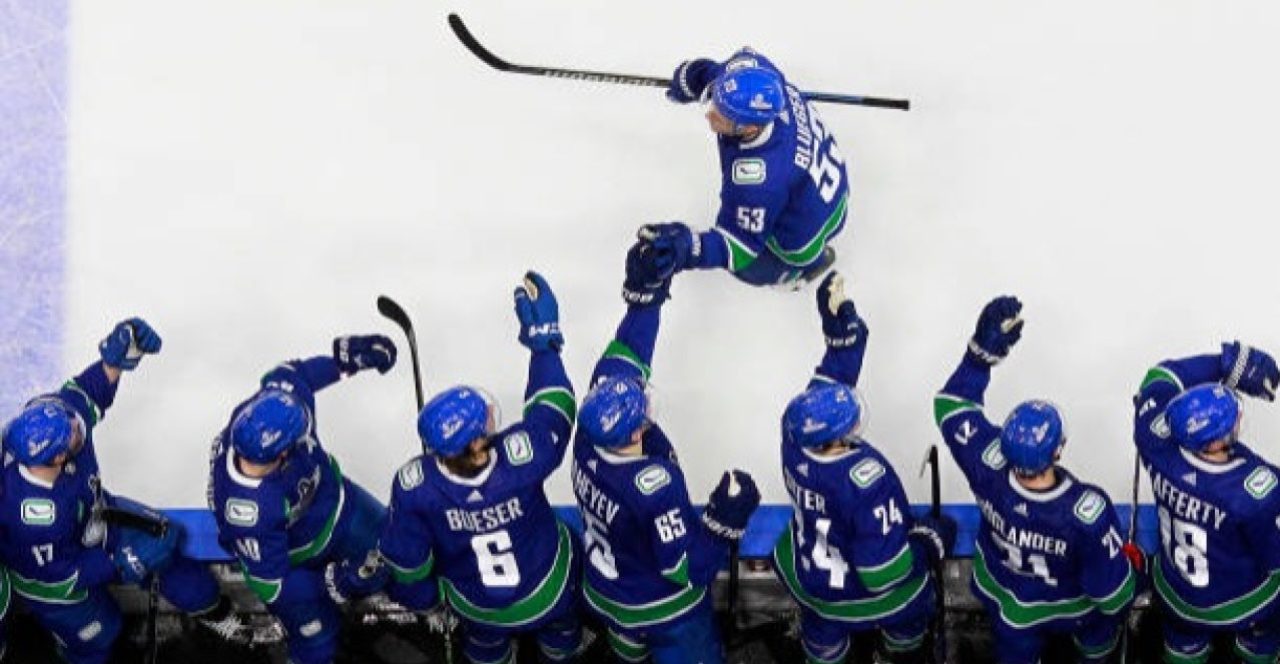
- Teddy Blueger, having returned from a three-month injury absence just before the Olympic break, has used the post-Olympic window to showcase the defensive metrics and penalty-killing prowess that make him an attractive rental for playoff-bound squads. His ability to stabilize a bottom-six unit is a known quantity across the league, and the Canucks are leveraging this interest to maximize their return for a player who likely does not fit the long-term timeline of the current rebuild.
The Elias Pettersson Conundrum: Benchings and Blockbusters
Perhaps no storyline is more distressing for the Canucks’ faithful than the deteriorating situation surrounding Elias Pettersson.
- Once the undisputed centerpiece of the franchise’s future, Pettersson’s 2025-26 campaign has been characterized by a sharp decline in production and visible friction with the coaching staff. The tension reached a boiling point during a recent 5-1 loss to the Seattle Kraken, where Head Coach Adam Foote benched Pettersson for the final 9:47 of the third period.
- Foote was blunt in his assessment, citing “performance-related reasons” and a need for his top players to be the difference-makers in critical moments. This sentiment echoed previous comments from General Manager Patrik Allvin, who stated that “unfortuately, I think we haven’t got the most out of those specific guys”.
- Pettersson, who signed a massive eight-year, $92.8 million contract extension only two years ago, has produced just 35 points in 51 games this season—a far cry from the 89-point pace he established in previous years.
- Rumors of a “massive deal” involving the Los Angeles Kings have begun to circulate, yet a Pettersson blockbuster remains a “logistical nightmare” during the season. His $11.6 million average annual value (AAV) and includes a full No-Movement Clause, giving Pettersson total control over his destination.
- Furthermore, reports indicate that the Canucks’ front office is currently unwilling to retain any salary in a potential deal, a stance that effectively cools the market for most contenders.
The organizational philosophy, as documented in professional sports,” emphasizes that a successful organization is a “partnership between ownership, management, coaches and the players”. When that partnership is tested by poor performance and public benchings, the “process” of roster construction becomes paramount. While a summer move for Pettersson seems more probable, the scouts from 15 NHL teams that recently crowded the Rogers Arena press box were certainly not there just to watch depth pieces.
The “Tank” for Gavin McKenna is now a tangible reality for the Vancouver fanbase. With a 20.5% chance at the first overall pick, the intentionality behind the recent losses serves as the “carrot” keeping fans engaged during this agonizing “roster purge”.
The Hurricanes: A Continental Juggernaut on a Mission
In stark contrast to the chaotic state of the Canucks, the Carolina Hurricanes (38-16-6, 82 points) arrive at Rogers Arena as one of the league’s most stable and formidable juggernauts. Currently sitting atop the Metropolitan Division, seven points clear of their nearest rivals, the Hurricanes are using this four-game Western road trip to fine-tune their game for what they hope will be a deep run toward the Stanley Cup.
Carolina recently saw a season-best 12-game point streak (10-0-2) snapped in a 2-1 loss to the Seattle Kraken. Despite outshooting the Kraken 36-15, the Hurricanes struggled with uncharacteristic turnovers and a failure to capitalize on a relentless offensive zone presence. Head Coach Rod Brind’Amour, ever the demanding taskmaster, noted that while the team “played well,” they must find ways to score more than one goal when dominating possession to the degree they did in Seattle.
The Hurricanes’ offense continues to be paced by the dynamic Sebastian Aho, who has recorded 59 points in 60 games—a point-per-game pace that underscores his consistency and leadership. What makes Carolina terrifying for opponents is their balanced depth. Players like Seth Jarvis, who leads the team with 26 goals, and Andrei Svechnikov provide a level of offensive punch that ensures the team remains dangerous even when their top line is stifled.
Nikolaj Ehlers has been a “fantastic veteran depth piece” for the Hurricanes, recently preventing a shutout against Seattle and adding a point in four of his last five outings. This ability to find scoring from multiple sources is the hallmark of a Brind’Amour-led team.
Goaltending Disparity: The Bussi Breakout vs. Lankinen’s Burden
The goaltending matchup tonight highlights the different trajectories of these two organizations.
Brandon Bussi: The Breakout Story
For Carolina, the story of the season has been the emergence of Brandon Bussi. With a staggering 24-3-1 record and a 2.23 goals-against average (GAA), Bussi has become the primary reason for the Hurricanes’ defensive reliability. His.906 save percentage ranks among the top 20 in the league, providing the “Canes” with a reliable last line of defense while veteran Frederik Andersen rotates in to manage workload. Bussi’s breakout has solidified Carolina’s position as a Cup contender.
Kevin Lankinen: Alone in the Crease
In Vancouver, Kevin Lankinen has shouldered a heavy load behind a defense that allows a league-high 3.70 goals per game. With Thatcher Demko on long-term injured reserve (LTIR) following season-ending hip surgery, Lankinen has been left to face the “Victory Green” juggernauts and “Caniac” assaults with little support. Sporting a sub-.880 save percentage and having lost his last six decisions, Lankinen will likely need a “save of the year” performance tonight just to keep the Canucks in the game.
Special Teams: A Statistical Implosion
The disparity in special teams tonight is a damning indictment of the Canucks’ current form. Vancouver possesses the league’s 32nd-ranked penalty kill, operating at a dismal 70.62%. This weakness is exacerbated by a high volume of penalties, notably from Evander Kane, whose 78 PIMs lead the team. Conversely, Carolina’s power play, while currently 13th in the league, has shown a “renaissance” as of late, bolstered by the puck-moving ability of Shayne Gostisbehere.
If the Canucks find themselves in penalty trouble tonight, this contest could “get ugly fast,” as the Hurricanes’ disciplined approach rarely affords opponents the same opportunities to capitalize on the man advantage.
Management Philosophy: Accountability
The collaborative leadership of Foote, Allvin, and Rutherford (the FAR team) is built on high trust and a player-led culture of accountability. Coach Adam Foote’s “It’s Their Room” doctrine is seen as a response to previous dysfunction, yet the actual results have led to skepticism regarding the core’s strength.
Management believes that “identity” fuels consistency, yet Patrik Allvin has admitted that the team’s identity has been “very vague” this season. The 2025 trades of Miller and Hughes signaled a “structural dismantling” that ownership—invested for two decades and hungry for immediate returns—has reportedly monitored with an ultimatum.
The pressure to move veterans with remaining contract term before the March 6 deadline is the ultimate test of Allvin’s “never-ending pursuit of excellence”.
From a bureaucratic perspective, the current Canucks roster is burdened by “roster baggage”—expensive veterans who occupy roles that prospects like Lekkerimaki, Willander, and the “NextGen” core are destined to fill.
To rebuild properly, management must resolve the belief of maintaining these veterans as “untouchable” while simultaneously declaring a rebuild. tonight’s game serves as a final evaluation period for players like Conor Garland and Brock Boeser, whose futures in Vancouver remain subject to the “Rebuilder’s Mandate”.
Injury Reports and Roster Fluctuations
Both teams are navigating significant health issues that will impact tonight’s lineup and the tactical approach of their respective coaches.
The Canucks recently recalled Victor Mancini from the AHL’s Abbotsford Canucks following an upper-body injury to Pierre-Olivier Joseph. Joseph was placed on IR, retroactive to March 2, after taking X-rays on a shoulder injury suffered against Seattle. With Thatcher Demko moved to season-ending LTIR (clearing over $11 million in cap space for potential deadline moves), the Canucks are operating with a skeleton crew on the back end.
Carolina is dealing with its own “injury wave” that has hit their veterans. Shayne Gostisbehere, who leads the Hurricanes’ blueline in scoring with 32 points, has dealt with midsection and lower-body injuries all season. William Carrier also remains out with a lower-body injury, depriving the team of his physical edge. Despite these absences, the Hurricanes have been able to weave in call-ups and maintain their high-possession style, a testament to the organizational depth built by Don Waddell and Rod Brind’Amour.
Roster Management & Recalls
- Tyler Myers (D): TRADED. In a breaking move, Myers was traded to the Dallas Stars for a 2nd-round pick (’27) and a 4th-round pick (’29). He will obviously not be in the lineup.
- Victor Mancini (D): Recalled from AHL Abbotsford to fill the void left by Myers and Joseph.
- Trade Watch: Elias Pettersson remains the subject of intense rumors (specifically linked to Detroit and Carolina), but he is expected to play tonight unless a “roster management” scratch is announced late.
The Canucks are dealing with a significant amount of long-term injuries, which has opened up cap space for their deadline maneuvering.
Vancouver Canucks Roster & Injury Report
| Player | Status | Injury Type | Impact / Notes |
| Thatcher Demko (G) | LTIR | Hip | Shut down for the season; recently moved to LTIR to clear $3.82M–$5M in cap space. |
| Derek Forbort (D) | LTIR | Undisclosed | Has been on LTIR since late October; unlikely to return soon. |
| Filip Chytil (C) | IR | Facial | Placed on IR on Feb 25; out indefinitely with a facial fracture. |
| Marco Rossi (C) | IR | Lower Body | A recent addition to the IR; creates a massive hole in the middle six. |
| PO Joseph (D) | IR | Upper Body | Placed on IR (retroactive to March 2) after leaving Monday’s game. |
| Brock Boeser (RW) | IR | Undisclosed | Recently added to IR; his absence is a major blow to the top six. |
| Zeev Buium (D) | IR | Undisclosed | The star defensive prospect is currently sidelined on IR. |
| J. Lekkerimaki (F) | Out | Surgery | Recovering from recent surgery. |
Special Teams: A Statistical Implosion
The disparity in special teams tonight is a damning indictment of the Canucks’ current form. Vancouver possesses the league’s 32nd-ranked penalty kill, operating at a dismal 70.62%. This weakness is exacerbated by a high volume of penalties, notably from Evander Kane, whose 78 PIMs lead the team. Conversely, Carolina’s power play, while currently 13th in the league, has shown a “renaissance” as of late, bolstered by the puck-moving ability of Shayne Gostisbehere.
If the Canucks find themselves in penalty trouble tonight, this contest could “get ugly fast,” as the Hurricanes’ disciplined approach rarely affords opponents the same opportunities to capitalize on the man advantage.
| Metric | Vancouver | Carolina |
| Goals For Per Game | 2.48 (30th) | 3.44 (5th) |
| Goals Against Per Game | 3.70 (32nd) | 2.81 (7th) |
| Power Play % | 17.68% (23rd) | 13th overall |
| Penalty Kill % | 70.62% (32nd) | 80.4% (11th) |
| Goal Differential | -73 (32nd) | +36 (5th) |
Tonight’s game at Rogers Arena is less a contest for points and more a “final showcase” before the structural dismantling of the Vancouver roster is finalized. For the Hurricanes, it is an opportunity to bounce back from a rare loss and re-establish the dominance that has characterized their Metropolitan-leading season. For the Canucks, it is the “rubber match” of a season defined by failure, benchings, and the painful process of starting over.
Until next time, hockey fans
